The FrugalLiving Money System: What to Fix First and What to Automate
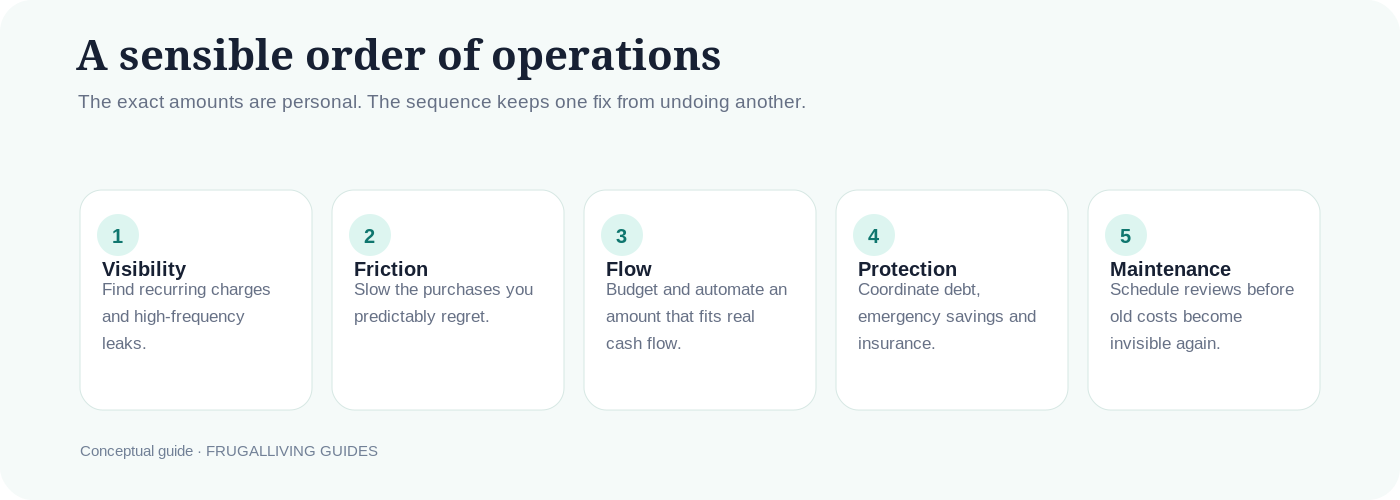
When money feels tight, the instinct is to attack everything at once: budget harder, cancel subscriptions, pay debt faster, save more, stop shopping. That usually creates a pile of good intentions instead of an order of operations. This guide gives each problem a job — and puts the jobs in a sequence that can survive an ordinary month.
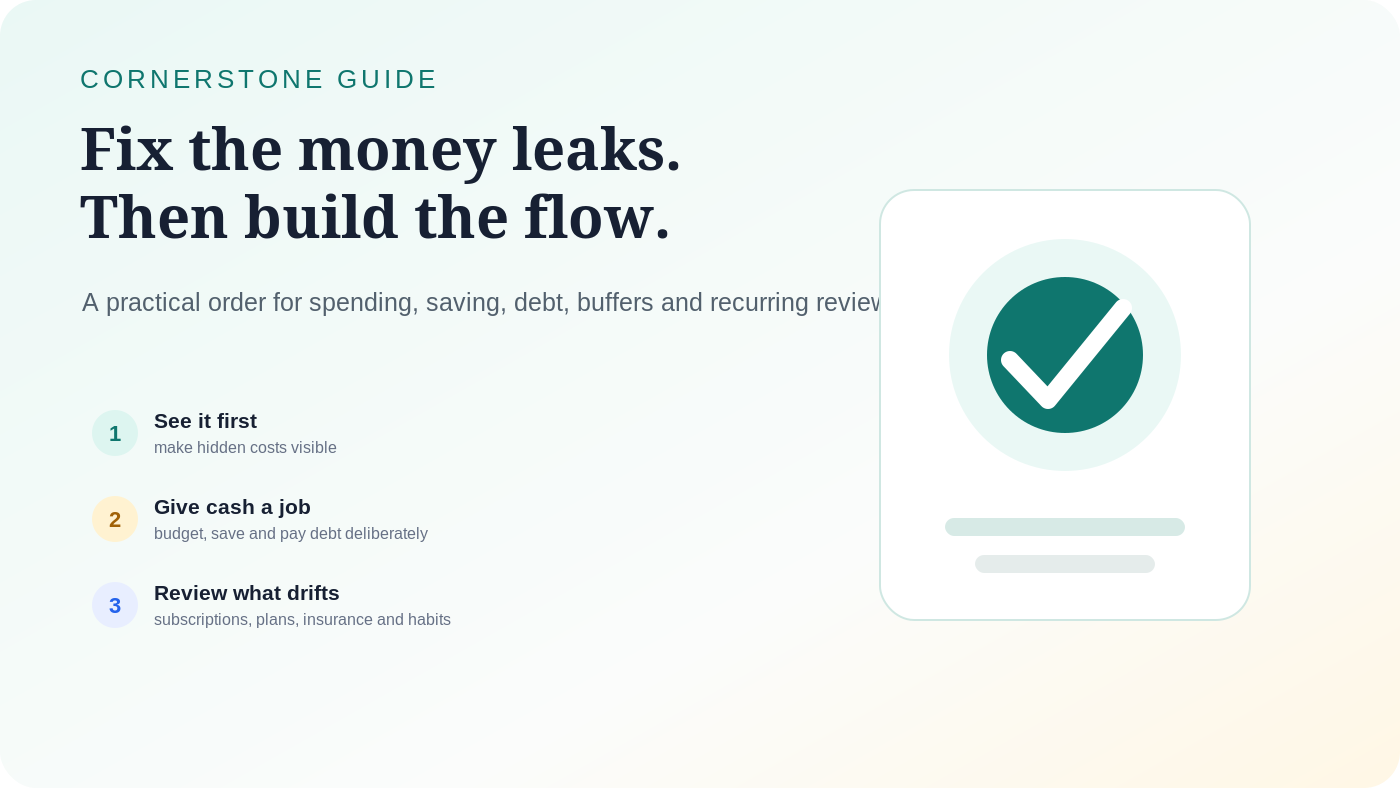
Quick verdict: Start with visibility. Remove obvious waste. Slow down the purchases you repeatedly regret. Give freed cash a destination. Build enough liquidity to keep routine surprises off expensive debt. Review insurance before cutting it. Then schedule maintenance so the fixes do not quietly expire.
This is the cornerstone guide for the current FrugalLiving Guides money cycle. It is not a promise that one sequence fits every household perfectly. If bills are already delinquent, housing is unstable, a debt is in collections, or a policy/legal deadline is involved, those consequences can override the normal order.
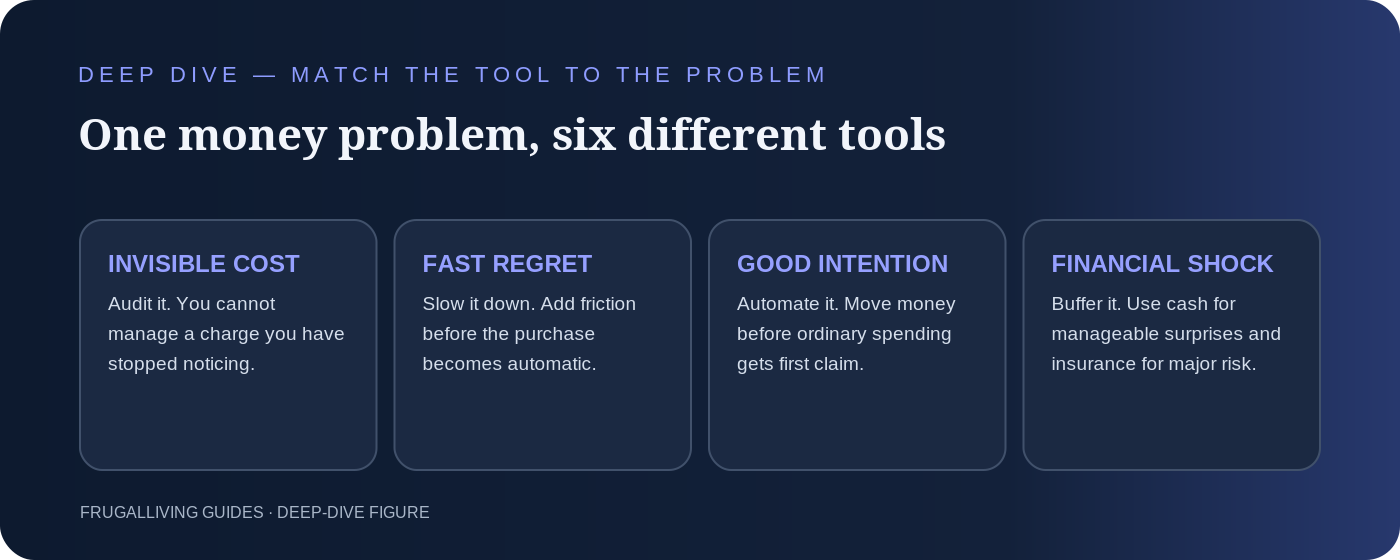
The mistake is treating every money problem as the same problem
A subscription you forgot is not solved the same way as a grocery habit.
An impulse purchase is not solved the same way as a car repair.
A debt balance is not solved the same way as an insurance gap.
The useful question is:
What kind of problem is this — and what tool actually fits it?
That distinction matters because “try harder” is not a useful financial category.
Some costs need an audit. Some decisions need friction. Some goals need automation. Some risks need cash. Some risks belong in an insurance contract. And anything that can drift needs a review date.
Stage 1 — Make the invisible visible
Do this before building an elaborate budget.
Run one short spending diagnostic
A no-spend week can be useful when you treat it as observation, not punishment.
Pause a defined slice of non-essential spending and note what still pulls at you. Boredom? Payday? A commute? Social media? A stressful evening?
The dollar total is less useful than the pattern.
→ Use a No-Spend Week to Find Your Spending Triggers
Surface recurring charges
Look through bank statements, card statements, app stores and email receipts.
Then ask:
Would I sign up for this again today at this price?
If yes, keep it deliberately. If no, it belongs on the cancellation list.
→ The Subscriptions You Forgot You’re Paying For
Check the normal expenses that quietly drift
Groceries, utilities and phone service are ordinary expenses. That is why increases can hide in plain sight.
Review:
- grocery trip frequency, unit prices and waste;
- utility rate plans, large loads and worthwhile standby use;
- phone data use, add-ons, device financing and current alternatives.
→ The Grocery Store Is Making Decisions With You
→ Your Electronics Are Still Using Power While “Off”
→ You May Be Paying for Data You Never Use
Free resource → The 20-Minute Money Leak Audit
Stage 2 — Put time between wanting and buying
Recurring charges are mostly visibility problems.
Impulse purchases are timing problems.
Purchase research does not support the cartoon version that “dopamine makes people shop.” A better takeaway is that reward-related and price-related signals can shape a purchase decision before checkout, and context matters.
That gives you a practical lever: time.
Try the smallest amount of friction that interrupts the pattern:
- remove a stored card from one problem site;
- turn off shopping notifications;
- use a dated wish list;
- create a waiting rule that fits the size of the purchase;
- unsubscribe from the marketing stream that reliably starts the loop.
You do not need to make buying unpleasant.
You need to make the purchases you often regret a little slower.
→ Why the Urge to Buy Peaks Before You Own the Thing
Stage 3 — Give the freed cash a destination
Cutting waste creates room.
It does not decide what happens to the room.
Automate an amount that survives a normal month
The useful first transfer is not the largest amount you can tolerate once. It is the amount that can keep running through a month with groceries, school costs, a birthday, an imperfect paycheck or a slightly higher utility bill.
Schedule around cash flow. Keep enough checking room to avoid creating overdrafts or payment stress.
The CFPB points to recurring transfers as one way to make emergency saving more consistent.
→ Make Saving Happen Before You Can Spend It
Use the budget for decisions, not archaeology
Tracking tells you what happened.
A budget should help decide what happens next.
Start with:
- take-home income;
- fixed obligations;
- savings and debt priorities;
- flexible money left.
Add detail only where it changes a decision.
For annual or irregular costs, use sinking funds so one month does not have to absorb an expense that belongs to the whole year.
→ A Budget Should Decide Before You Spend
Stage 4 — Coordinate debt with a cash buffer
Debt payoff and emergency savings are often presented as competing teams.
They are better understood as two defenses against the same problem: expensive financial setbacks.
A household with no cash buffer can make fast credit-card progress and then reverse it with one repair.
A household that keeps accumulating cash while carrying very high-cost revolving debt can also be paying a large price for caution.
The balance depends on the household.
Choose a debt order deliberately
If minimizing interest is the priority, highest-interest-first is usually the mathematical choice when payment amounts and timing are otherwise the same.
If quick balance closures make the plan easier to sustain, snowball can be a behavioral trade-off. The CFPB describes both approaches and notes that snowball can cost more overall while producing faster visible progress.
→ How to Pay Off Debt in the Right Order
Build emergency savings in layers
Do not confuse one benchmark with a universal target.
In the Federal Reserve’s 2025 SHED, released in May 2026, 63% of adults said they would cover a hypothetical $400 emergency completely using cash or its equivalent. The report also found 55% said they had set aside enough in a rainy-day fund to cover three months of expenses.
Those are measures of household liquidity — not instructions that everyone needs the same dollar amount.
Start with the kind of shock your household is most likely to face, then build from there.
→ How Much Emergency Fund Do You Actually Need?
Stage 5 — Audit insurance before changing it
Insurance is not another subscription.
A cheaper premium can mean a higher deductible, lower limit or missing protection.
Review:
- the facts the insurer is using;
- limits and deductibles;
- major exclusions;
- endorsements;
- life changes;
- and whether comparison quotes are truly comparable.
Then look for discounts and pricing improvements.
→ The Insurance Audit: Cut Costs Without Cutting the Protection You Need
Stage 6 — Recover value from things you no longer use
Decluttering can return a little cash.
The more interesting information is the pattern in what you never used.
Unused hobby gear, duplicate kitchen tools, productivity gadgets, aspirational clothing — repeated categories can show you where future spending needs more friction.
Sell when the return justifies the time.
Donate, recycle or dispose responsibly when it does not.
→ Before You Donate It, Check What It Could Sell For
A four-week installation plan
Week 1 — Visibility
- run the Money Leak Audit;
- cancel obvious unused subscriptions;
- check three months of phone usage;
- pick one grocery habit to measure.
Week 2 — Friction
- identify one recurring impulse trigger;
- remove one saved payment shortcut;
- create one personal waiting rule.
Week 3 — Flow
- set one realistic automatic transfer;
- build a simple forward-looking budget;
- choose a debt-payoff order if debt is part of the plan.
Week 4 — Protection
- define the next emergency-savings layer;
- review insurance limits, deductibles and obvious gaps;
- clear one batch of unused items.
You will not have “finished personal finance.”
You will have a smaller set of decisions that no longer need to be reinvented every week.
Maintenance is part of the system
A good fix can become stale.
A new subscription appears. A phone plan gets old. Insurance renews. Income changes. Grocery habits drift.
That is why a review date matters.
Free printable → The 12-Month Money-Saving Maintenance Calendar
The calendar gives one recurring money job to each month so you do not need to think about every category all the time.
The one idea to keep
Recurring problems deserve recurring responses.
Audit what becomes invisible.
Slow down what happens too fast.
Automate what deserves to repeat.
Keep cash for shocks you can absorb.
Use insurance for risks you cannot comfortably carry.
Schedule reviews for anything that can drift.
That is the FrugalLiving money system.
Sources & further reading
- Consumer Financial Protection Bureau — An essential guide to building an emergency fund
- Consumer Financial Protection Bureau — How to reduce your debt
- Federal Reserve — Economic Well-Being of U.S. Households in 2025 (released May 2026)
- Federal Trade Commission — guidance on free trials, auto-renewals and negative-option subscriptions
- Lawrence Berkeley National Laboratory — Standby Power
- Federal Communications Commission — Broadband Consumer Labels
- National Association of Insurance Commissioners — consumer insurance resources