Use a No-Spend Week to Find Your Spending Triggers
A no-spend challenge is more useful when you stop treating it as a punishment. Run it as a short experiment: pause non-essential spending, record the urges that show up, and use that evidence to change what happens next. The money you save is useful. The pattern you uncover can be worth more.
Most no-spend challenges are framed the same way: cut non-essentials for a fixed period and see how much you can save. That can work as a reset. But if spending returns the moment the challenge ends, the more useful question is what the pause revealed.
A rebound does not automatically mean the challenge failed. It may mean you treated the challenge as a finish line instead of a chance to collect evidence.
First, make the urge visible
Before you blame yourself for “having no self-control,” understand what you’re actually up against. Many modern payment and shopping experiences reduce friction between wanting something and completing the purchase.
Behavioral researchers use the phrase “pain of paying” to describe the psychological discomfort associated with spending. In experiments by MIT researchers Drazen Prelec and Duncan Simester, willingness to pay was higher in some credit-card conditions than in cash conditions. That does not mean every card purchase makes everyone spend more; it shows that payment format can change how a purchase feels and how much people are willing to pay.
Now layer on what happens before you buy. In a 2007 fMRI purchasing study, activity in reward-related regions while people viewed products helped predict later buying decisions, while price-related signals also mattered. The useful point is not that a single “buy button” exists in the brain. It is that desire and cost are being weighed before the purchase is complete.
So use the challenge to slow the sequence down. The point is not to prove that you can resist everything. It is to catch the moment between urge and purchase.
What a no-spend challenge really does
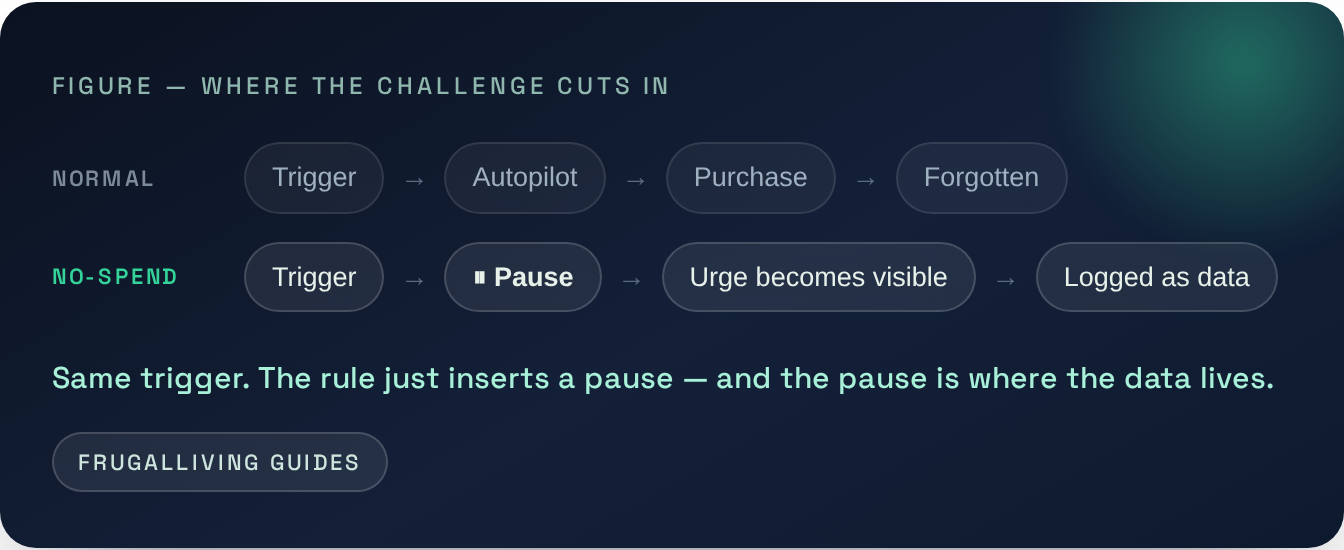
Strip away the “be disciplined” framing and here’s the mechanism that matters: a no-spend period turns off autopilot.
Most of your spending is automatic — it happens below the level of conscious decision. You don’t decide to buy the coffee; you’re just holding it. A no-spend rule forces a pause into that automatic loop. And in that pause, something valuable appears: the urge itself, now visible, waiting to be noticed.
That urge is the data. Not the dollars. The dollars are just the receipt for information you already had access to but never wrote down.
How to run it as an experiment, not a punishment
The setup matters more than the willpower. Do this:
1. Define the rules before you start. Write down what counts as essential (rent, groceries, medicine, transport to work) and what counts as non-essential (everything else). Vagueness is what kills these challenges on day three — you negotiate with yourself in the moment and lose.
2. Start with 7 days, not 30. A week is long enough to surface your patterns and short enough that your brain doesn’t file it under “deprivation” and rebel. You can always extend. A failed 30-day run teaches you less than a completed 7-day one.
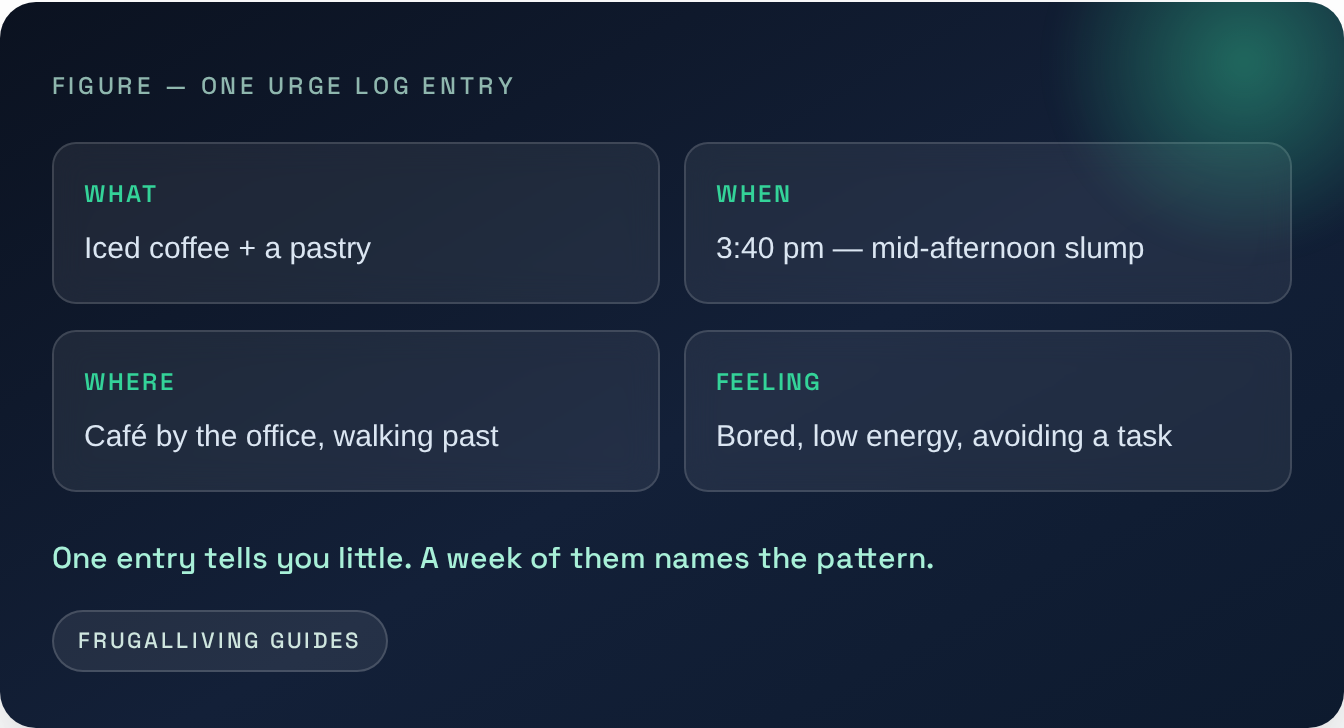
3. Keep an Urge Log — this is the whole point. Every time you want to buy something non-essential, do not just resist it. Write down four things: what you wanted, when it hit, where you were, and what you were feeling. That log is the actual deliverable of the challenge. At the end of the week, you won’t have a pile of saved cash so much as a document that explains you to yourself.
4. Use a “parking lot.” When a real want shows up, add it to a list to reconsider after the challenge. This does two things: it lowers the pressure that causes rebound, and it reveals how many of those “must-haves” you don’t even want a week later. Most of them, it turns out.
Why rigid challenges can backfire
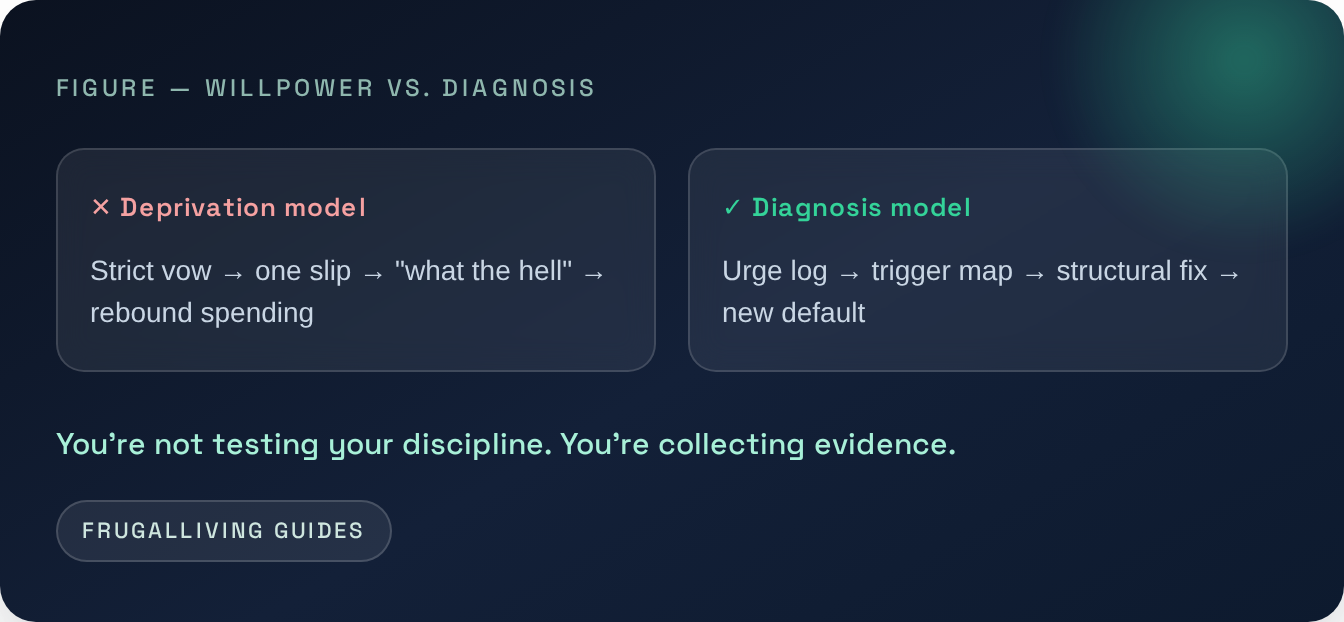
If you frame the month as deprivation, you’ve already lost — and there’s a specific psychological reason.
Research on rigid restraint in other behavioral domains describes a familiar pattern: once a strict rule is broken, people can be tempted to abandon the rule entirely. Money is not dieting, so treat this as an analogy rather than a direct financial finding. The practical lesson is still useful: one unplanned purchase does not have to end the experiment.
Then there’s present bias — the brain’s built-in tendency to overweight the reward in front of you and discount the benefit that’s weeks away. The savings are abstract and future. The thing you want is concrete and now. Willpower alone loses that matchup most days.
The fix isn’t more willpower. It’s changing what you think you’re doing. A diet you can fail. A diagnosis you can’t — every urge you log is a success, including the ones you give in to, because the point was to see them, not to defeat them.
INFOGRAPHIC — Glass Dark style
The real payoff: your urge log becomes a system
At the end of the week, read your log and cluster the entries. Almost everyone’s urges fall into a handful of buckets:
- Boredom — buying to fill dead time (commutes, evenings, waiting).
- Stress / emotion — the purchase is a mood fix, not a need.
- Social — spending that’s really about being around other people spending.
- Convenience — paying to remove a tiny friction (delivery, one-click).
- Sale / FOMO — the discount created the desire; the desire didn’t exist first.
Here’s why this matters more than the money saved: each cluster has a structural fix that requires zero ongoing willpower.
Boredom spender? The fix isn’t “resist harder” — it’s putting something else in the dead time. Sale-FOMO? Unfollow the deal accounts and unsubscribe from the promo emails; you can’t crave what you don’t see. Convenience? Delete the saved card so one-click becomes five-click. Stress? The purchase was treating a real feeling — build a non-spending response to that feeling instead.
This is the whole philosophy of this site in one exercise: money problems are almost never willpower problems. They’re design problems — and design problems have design solutions. You don’t white-knuckle your way to better spending. You rearrange the environment so the good choice is the easy one.
The trigger you can’t even see
There’s one category the no-spend challenge won’t catch, and it’s often the biggest: the spending that doesn’t require an urge at all.
A no-spend week makes your active spending visible — the coffee, the cart, the impulse buy. But underneath all of that, silent recurring charges keep firing on schedule whether you feel an urge or not. No decision. No pause. No log entry. Just money leaving, month after month, for things you signed up for once and forgot.
That’s the next hunt — and for most people, it’s where the first real money is hiding.
The scoreboard that actually matters
Stop measuring a no-spend challenge in dollars saved. Measure it in how well you now understand your own spending. The dollars follow the understanding — not the other way around.
Run the week. Keep the log. Cluster the triggers. Then turn each trigger into one small structural change. That’s not a month of suffering you have to repeat forever. It’s a one-time diagnostic that quietly rewires the defaults you’ll live inside from now on.
Then go find the invisible ones.
Next in this series → The Subscriptions You Forgot You’re Paying For — how to find and kill the silent recurring charges a no-spend challenge can’t see. (coming next)
This article is part of the larger guide: Why You Can’t Save Money — And the System That Fixes It.
Use a seven-day version before you attempt a month
Thirty days sounds serious. Seven days often produces better information because you are more likely to finish it and review the notes.
For one week, keep essential spending normal and pause only the discretionary category you want to understand. Each time you want to spend, write:
what I wanted / what triggered it / what I did instead / whether I still wanted it the next day
At the end of the week, circle the trigger that appeared most often.
That trigger becomes the next system change. If late-night shopping appears three times, remove the app from the phone. If takeout appears after long workdays, the solution may be two freezer meals rather than a stronger lecture about discipline.
The challenge earns its keep when it changes the environment after the challenge ends.
Continue the money-saving cycle
Sources & further reading
- Prelec, D. & Simester, D. (2001), Always Leave Home Without It: A Further Investigation of the Credit-Card Effect on Willingness to Pay — https://doi.org/10.1023/A:1008196717017
- Knutson, B. et al. (2007), Neural Predictors of Purchases, Neuron / PubMed — https://pubmed.ncbi.nlm.nih.gov/17196537/
- The “pain of paying” is a behavioral-economics framework, not proof that every cashless purchase increases spending.
- Present bias and restraint concepts are used here as decision-making context; they do not establish that every no-spend challenge produces the same rebound.