The Subscriptions You Forgot You’re Paying For
Subscriptions are dangerous for one simple reason: the decision to start paying and the decision to keep paying happen at different times. A small charge can stay alive for months after the value is gone. The cure is visibility.
In the last article, we ran a no-spend challenge and treated it as a diagnostic — a way to see the urges that drive your active spending. But there’s a whole layer of spending underneath that a no-spend week can’t touch, because it needs no urge at all. No decision. No cart. No moment of temptation to catch. Just a charge that fires on schedule while you’re asleep.
These are your subscriptions, and many people underestimate how much the stack costs.
You don’t forget by accident
Forgetfulness is not the whole story. Recurring billing is designed to continue until you act, which makes visibility and cancellation friction worth paying attention to.
Recurring-revenue businesses benefit when customers stay subscribed, including customers who use a service less than they once did. That makes cancellation friction and automatic renewal worth noticing. Consider how it’s built:
- The free trial that converts to paid. Some offers begin charging when the trial ends unless you cancel. The FTC classifies these arrangements under negative-option marketing and advises consumers to check renewal and cancellation terms before signing up.
- Cancellation friction. Some services make leaving take more steps than joining. Regulators have repeatedly focused on recurring-billing practices where enrollment is easy but cancellation is confusing or obstructive.
- Price creep. The service that was a few dollars quietly becomes more, one small increase at a time, each too small to notice and act on.
- Small prices that are easy to ignore. A few dollars here and there may not trigger much attention on a statement. The useful number is the total recurring stack, not the smallest individual charge.
None of this requires you to be careless. It’s aimed at a normal person with a normal amount of attention, and it works on almost all of them.
The cost is in the pile, not the item
A 2022 C+R Research survey found a striking estimation gap: respondents first estimated about $86 a month in subscription spending, then averaged about $219 after itemizing their recurring charges. More recent C+R reporting also found that 42% of respondents said they had stopped using at least one service but forgotten they were still paying for it. Survey results vary by sample and definition, but the practical point is solid: recurring charges are easy to underestimate.
The reason is simple math working against you. A single forgotten charge feels trivial. But small × several × forgotten × months is not trivial — it’s one of the largest recoverable amounts in a typical budget, and it recovers with zero lifestyle change. You’re not giving anything up. You’re just stopping payment on things you already weren’t using.
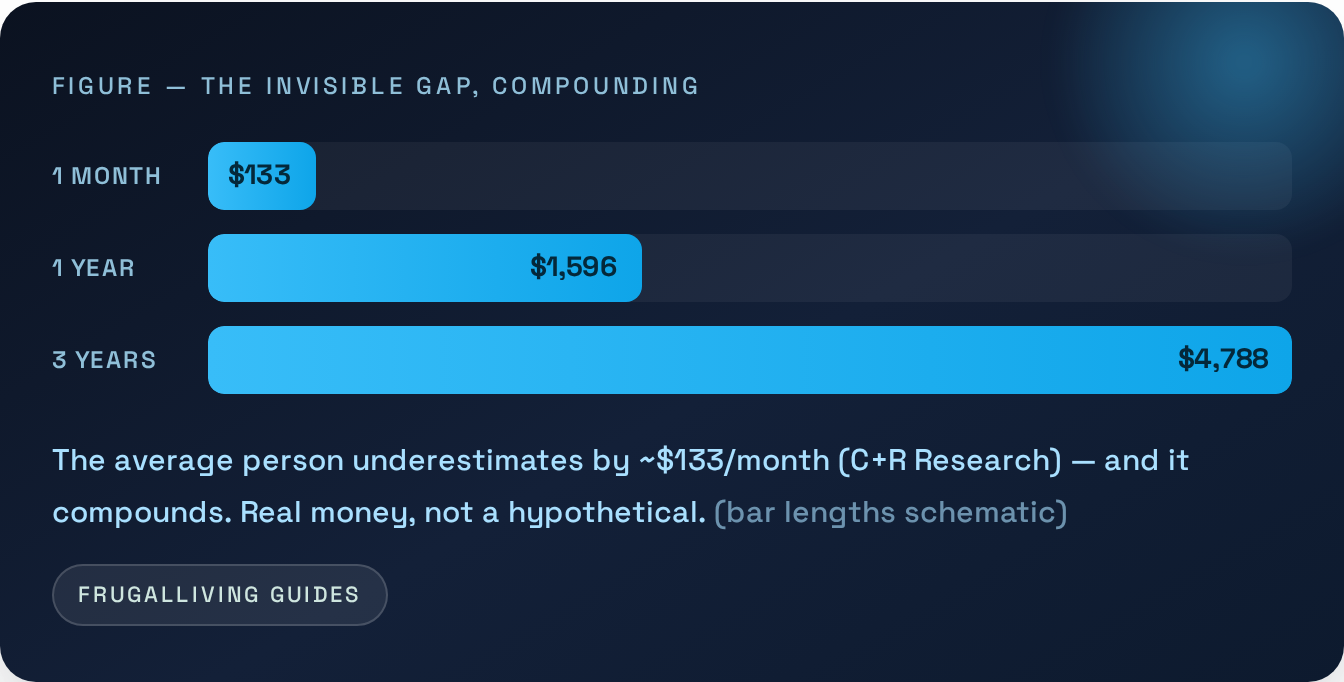
That is why a subscription audit can have an unusually clean payoff: you can cut spending without cutting something you still value. Find the full list first; then cancel only what you would not choose again.
The audit: find every one in three places
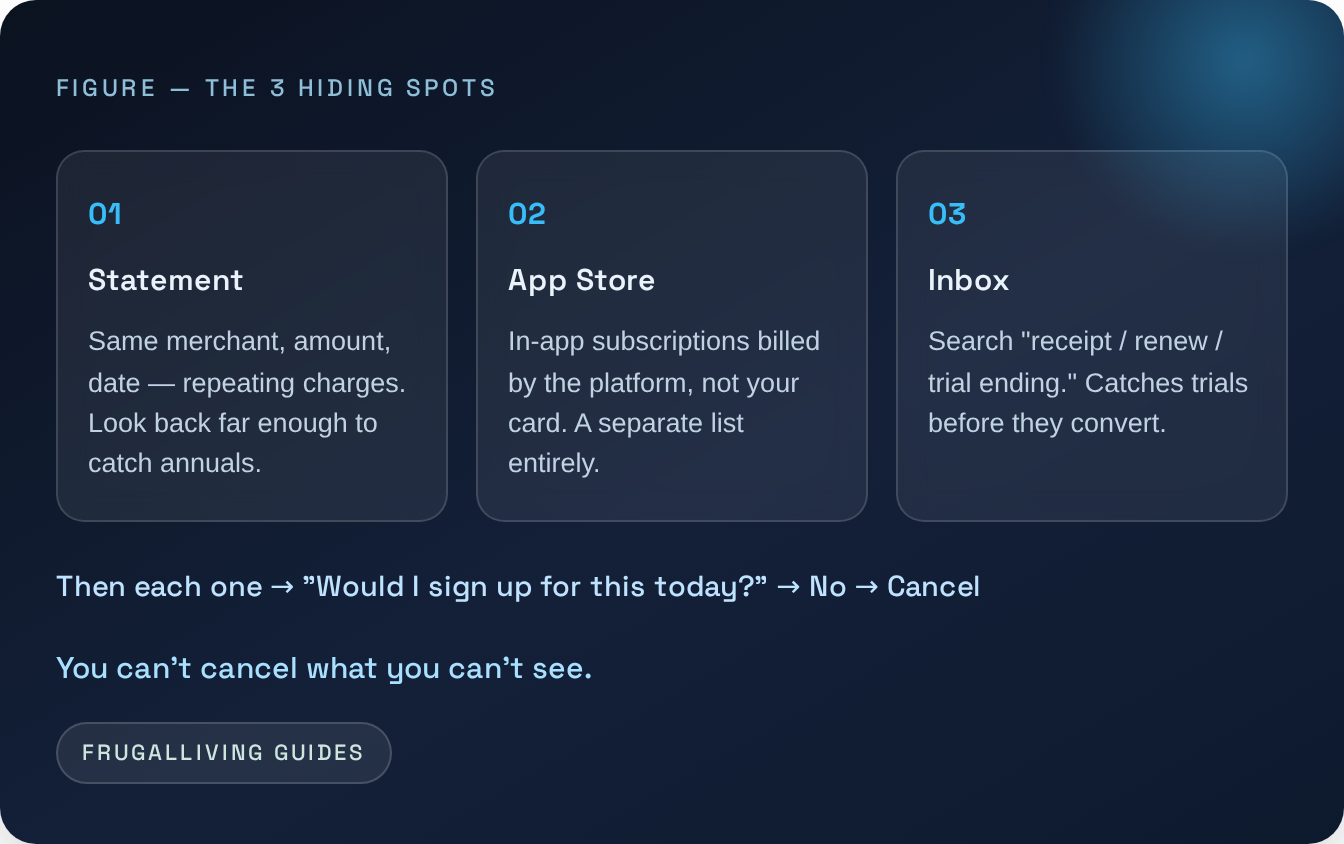
You can’t cancel what you can’t see, so the first job is pure visibility. Start with three places that catch most recurring charges. The list you remember from memory is rarely the safest list to trust.
1. Your statement. Scan your card and bank statements for the last two to three months, line by line. Recurring charges reveal themselves through repetition — the same merchant, the same amount, the same date. Annual ones only show up if you look back far enough, which is exactly why they’re the easiest to miss.
2. Your app store. On your phone, open the subscriptions page in your account settings (both major mobile platforms have one). Many subscriptions you started inside an app are billed here, not on your card statement — so this is a completely separate list from step 1.
3. Your inbox. Search your email for words like receipt, renew, your subscription, payment, and free trial ending. Most paid services send receipts, renewal notices or account emails, making the inbox a useful cross-check. This also catches the trials that are about to convert — the ones you can cancel before the first real charge.
The one question that cuts through inertia
Once you have the full list, don’t agonize. Run each subscription through a single test:
“If this weren’t already active, would I sign up for it today, at this price?”
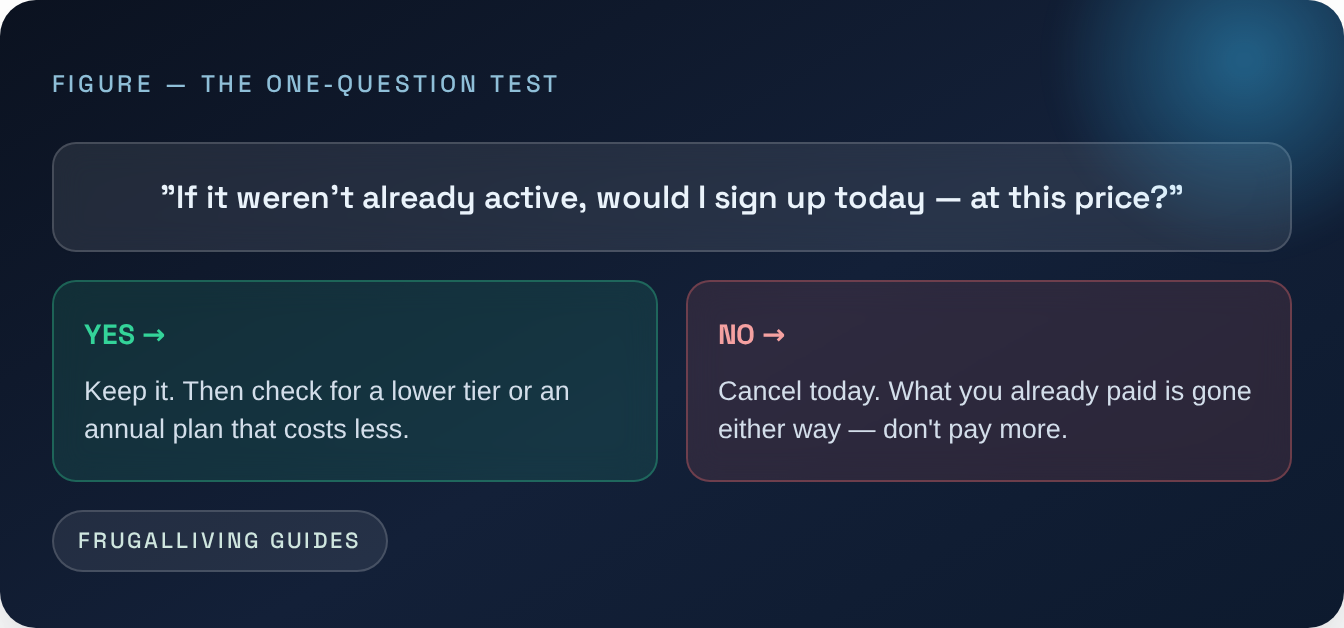
If the answer is no, cancel it. That’s it. The question strips away the trap you’re standing in — the sunk-cost fallacy, the feeling that because you’ve already paid for months, cancelling now “wastes” that money. It doesn’t. The money you spent is gone either way. The only question is whether to keep spending more.
Sort your list into three buckets as you go: use and love (keep), use rarely (the danger zone — be honest), and forgot it existed (cancel today, no debate).
INFOGRAPHIC — Glass Dark style
Getting past the exit traps
When you go to cancel, expect resistance — that’s the dark pattern doing its job. A few things help:
- The retention offer is data, not a gift. When they suddenly offer you a discount to stay, they’ve just told you the price was negotiable all along. Take it only if you’d have kept the service anyway; otherwise it’s a hook.
- “Pause” is often just a slower cancel. Pausing feels productive, but it frequently resumes billing on its own later. If you mean to leave, leave.
- If cancellation is genuinely blocked, you can usually stop the charge at the source — through the app store that bills it, or by contacting your card issuer. If a company continues charging after a valid cancellation, contact the merchant and then your payment provider about the dispute options available to you. Rules vary by country and payment method. (Note: cancellation rights vary by country — that’s a local layer worth checking for your region.)
Make it a system, not a one-time purge
Here’s where most people go wrong: they do one heroic cleanup, feel great, and let the pile rebuild over the next year. The audit only works if the visibility is permanent. Build these defaults so you never drift back:
- Put a recurring reminder on your calendar — once a quarter, re-run the three-place check. Fifteen minutes, four times a year.
- Corral subscriptions onto one card or account so every recurring charge lands in one visible place instead of scattered across everything.
- Turn off auto-renew wherever the service allows it, so keeping it becomes an active choice instead of a default.
- One-in, one-out. New subscription? Cancel one first. It keeps the pile flat by design.
The durable part is the schedule. You do not need to remember every subscription every day; you need one recurring moment when the entire list becomes visible again.
Next: the leak you see every week and still lose
Subscriptions are the money that leaves while you’re not looking. But there’s an expense that leaves while you are looking — one you review every single week and still overpay on, because the environment is engineered against you the moment you walk in.
It’s the biggest controllable line in most budgets, and willpower loses to it for a very specific, physical reason.
Make the list visible again
Find the full list in all three places. Ask the one question. Cancel what you would not choose again, keep what still earns its price, and set a quarterly reminder so the list does not disappear from view.
Then go look at the leak that’s been hiding in plain sight all along.
Next in this series → Your Grocery Bill Isn’t a Willpower Problem — why the store is built to beat you, and how to win on layout instead of self-control. (coming next)
This article is part of the larger guide: Why You Can’t Save Money — And the System That Fixes It.
Keep a cancellation log for anything that fights back
When a subscription is difficult to cancel, write down the date, the method you used, and any confirmation number or email.
Then check the next statement.
This sounds overly careful until a charge survives the cancellation and you no longer remember which screen you used or whether a confirmation arrived.
For annual renewals, add the renewal month to a simple maintenance calendar. You do not need to review every service every week. You need to see it before another year is purchased automatically.
Continue the money-saving cycle
- Previous: Use a No-Spend Week to Find Your Spending Triggers
- Next: The Grocery Store Is Making Decisions With You
Sources & further reading
- Federal Trade Commission, consumer guidance on free trials, automatic renewals and negative-option subscriptions — https://consumer.ftc.gov/articles/getting-and-out-free-trials-auto-renewals-and-negative-option-subscriptions
- Federal Trade Commission, Negative Option Rule and current rulemaking history — https://www.ftc.gov/legal-library/browse/rules/negative-option-rule
- Subscription and cancellation law is evolving; use current FTC/state guidance rather than relying on an old “click-to-cancel” headline.