A Budget Should Decide Before You Spend
If your budget only tells you what happened last week, it arrived too late. Tracking is useful evidence. A working budget uses that evidence to make the next decision before the money is gone.
Quick verdict: Start with four numbers — take-home income, near-term fixed obligations, chosen savings/debt priorities, and flexible money left. Use a simple framework such as 50/30/20 only as a starting reference, not as a score you can fail.
Tracking looks backward. Budgeting looks forward.
Expense tracking answers:
Where did the money go?
A budget should answer:
What can this money do before the next pay cycle?
You often need both.
Tracking can show that groceries have drifted, subscriptions have accumulated or transport costs were underestimated.
Budgeting turns that information into a choice for the next month.
That distinction keeps the budget from becoming a guilt diary.
Start with four numbers before you build categories
A budget can become a procrastination project.
Forty categories. Three apps. Color codes. And still no clean answer to:
What can I safely spend before the next paycheck?
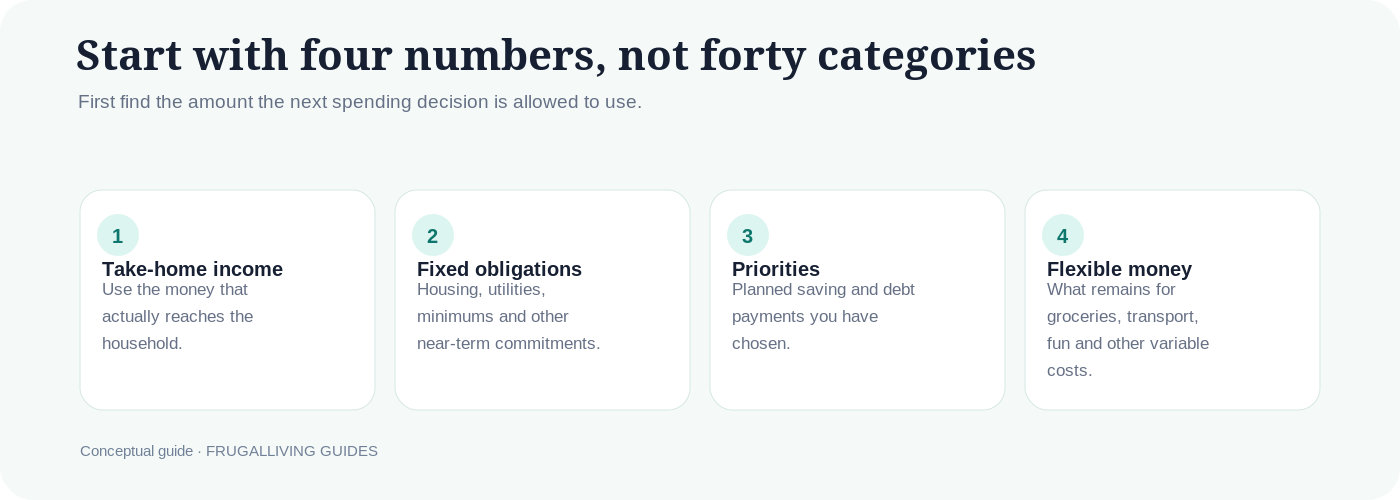
Start with:
- Take-home income — the money that actually arrives.
- Fixed obligations — housing, utilities, minimum payments and other commitments due in the period.
- Chosen savings and debt priorities — the transfers or extra payments you have deliberately planned.
- Flexible money left — the amount available for variable needs and wants.
Then add categories only where they improve a decision.
For one household, groceries / transport / fun / everything else may be enough.
For another, childcare, medical costs, business expenses or travel deserve their own lines.
Detail is useful when it changes behavior.
Use 50/30/20 as a reference, not a verdict
The CFPB has used the 50/30/20 rule as a common budgeting rule of thumb:
- roughly 50% of take-home pay for needs;
- 30% for wants;
- 20% for savings and debt goals.
That framework can be a useful first comparison.
It is not a universal target.
Housing costs, debt, childcare, location, disability-related expenses, income volatility and family structure can make another split far more realistic.
If your rent alone pushes “needs” above 50%, the useful response is not to declare the budget a failure.
The useful response is to see the constraint clearly.
Visible limits beat vague intentions
“Spend less on eating out” is an intention.
“$180 is available for eating out this month” is a limit.
The limit creates a visible trade-off.
When the category is nearly empty, you can:
- pause spending;
- move money deliberately from another flexible category;
- or revise the amount next month if the estimate was unrealistic.
That is much better than letting the checking-account balance make the decision silently.
Separate accounts or bank sub-accounts can help some people make categories feel more concrete, but they are not required.
The system can be envelopes, a spreadsheet, a notes app or bank buckets.
Use the simplest format you will still look at next month.
Variable income needs a floor, not a fantasy average
A strong month is dangerous when the budget quietly treats it as permanent.
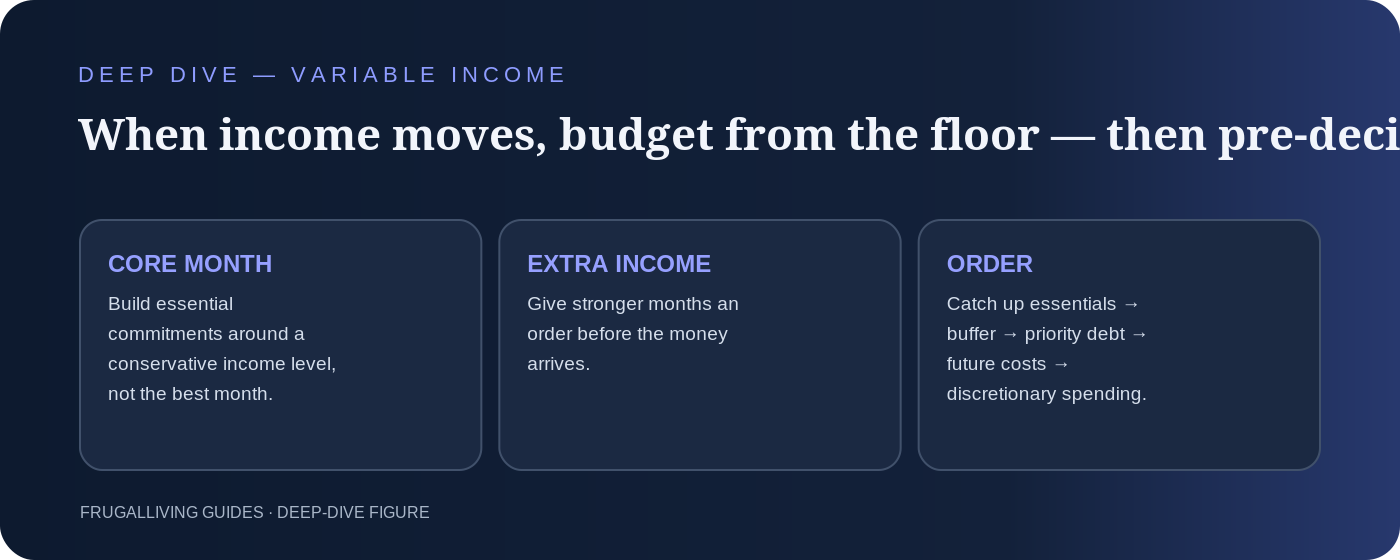
For variable income, start the core plan around a conservative income level you can reasonably expect, rather than the best month.
Then decide in advance what extra income does.
For example:
overdue essentials → emergency buffer → priority debt → future costs → discretionary spending
That order is only an example.
The important part is pre-deciding the order before the higher-income month arrives.
This can keep a temporary spike from turning into permanent monthly commitments.
Give irregular bills a monthly price tag
Annual insurance, registration, holiday spending, routine maintenance and school costs are not automatically emergencies.
Many are simply predictable bills with inconvenient timing.
If a known annual cost is $600, saving $50 a month gives that future bill a current price tag.
That is a sinking fund.
The cost has not changed.
The month it arrives has.
Sinking funds are especially useful because they keep predictable expenses from raiding the emergency fund.
Repair the plan instead of “starting over”
A useful budget is editable.
If groceries run $80 over, do not declare the month ruined.
Ask what the $80 means.
Was the estimate unrealistic?
Was there a one-time event?
Did another category come in under budget?
Does the plan need a deliberate trade-off?
Then repair it.
A budget that never changes is probably describing an imaginary household.
What if there is not enough money?
A budget cannot make insufficient income disappear.
If essentials and minimum obligations exceed take-home income, the budget has still done something valuable: it has made the gap visible.
At that point, the work changes from category optimization to triage:
- protect housing, utilities, food, transport and other essentials;
- understand minimum payment requirements and consequences;
- contact creditors or service providers early when hardship options may exist;
- avoid building a plan around money that is not there.
That is a different problem from “I need a better spreadsheet.”
What a working budget should tell you
At any point, you should be able to answer:
- What money is already committed?
- What future cost am I saving toward?
- What is available for flexible spending?
- What changed since last month?
- If I overspend here, where does the money come from?
If the budget cannot answer those questions, simplify it until it can.
Bottom line
Tracking is evidence.
Budgeting is a decision.
Use four numbers first. Treat percentage rules as references, not moral grades. Make irregular costs monthly. Build variable-income months from a conservative floor. And repair the plan when reality changes.
A budget is working when it helps you make the next trade-off on purpose.
Next in this series → How to Pay Off Debt in the Right Order
Part of the larger guide: The FrugalLiving Money System.
Sources & further reading
- Consumer Financial Protection Bureau — budgeting and financial education tools
- CFPB budgeting worksheets using the 50/30/20 rule as a common rule of thumb
- The percentages in this article are starting references, not universal targets.