Bundles Feel Cheaper Because the Expensive Part Is Harder to See.
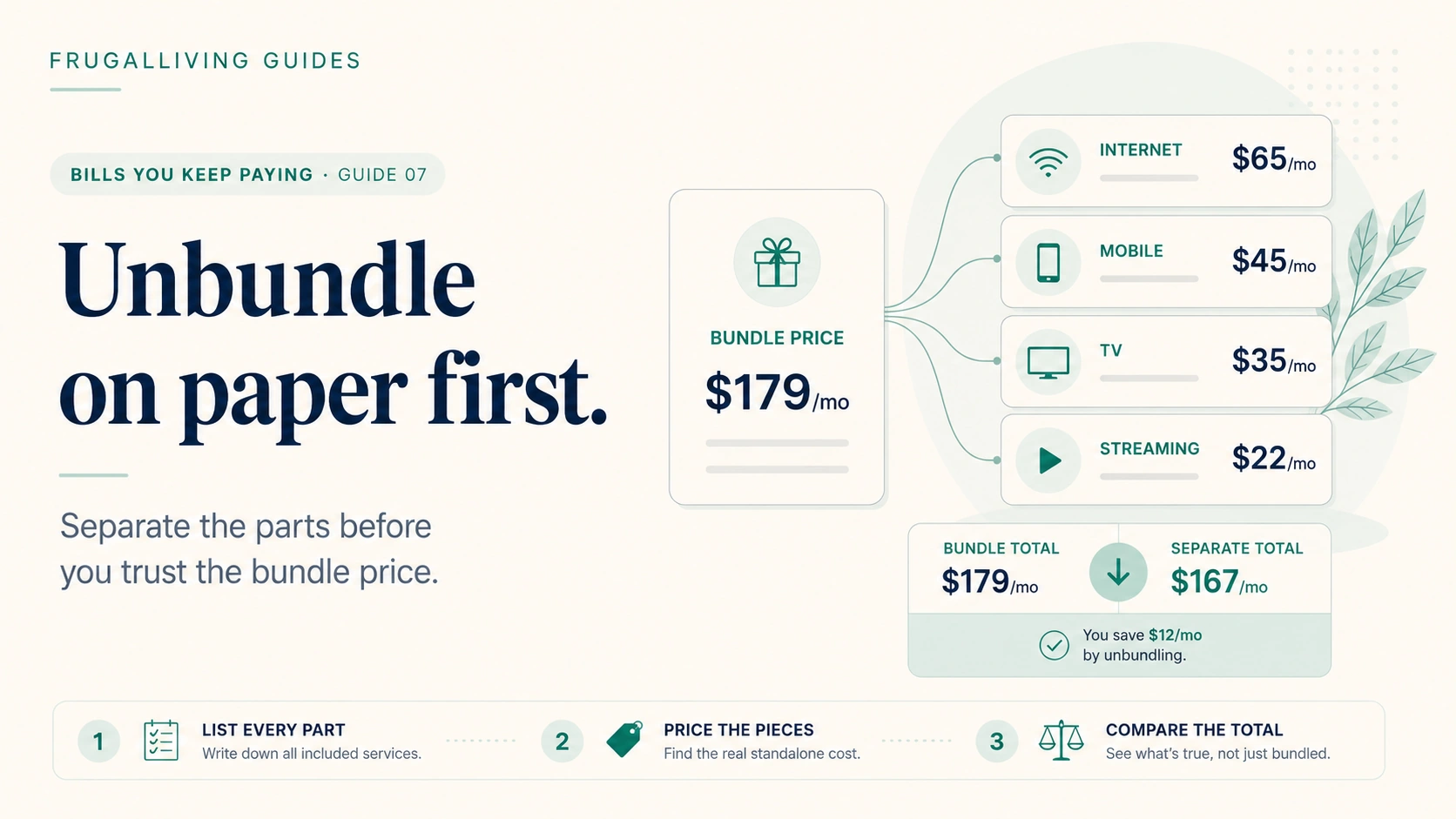
My take: A bundle is cheaper only if the total cost of the services you would buy separately is higher after you include equipment, discounts, taxes, and the post-promo price. Do the comparison on paper first. Never cancel part of a bundle until you know which discounts disappear and what the remaining services will cost afterward.
Bundles are very good at producing one reassuring number.
Internet + mobile + TV = $129.
Clean. Simple. Looks like a deal.
Then you try to remove the TV service you barely watch and discover the internet price changes, the mobile discount changes, the equipment fee stays, and somehow deleting a service saves $11 instead of the $50 you expected.
The problem is not that bundles are always bad.
The problem is that bundles make the price of each piece harder to see.
Unbundle it on paper before you unbundle it in real life
Do not call the provider yet.
Write down every service in the package and every discount attached to the package.
For example:
- internet;
- mobile lines;
- TV or streaming package;
- home phone;
- equipment;
- whole-home Wi-Fi;
- premium channels;
- autopay discount;
- multi-product discount;
- new-customer promotion;
- mobile-and-internet discount.
Then find the standalone price for the pieces you would keep.
For broadband, the FCC Broadband Facts label is useful because the label is designed around standalone mass-market broadband service and discloses core pricing and plan information. Providers may separately link to bundle discounts and other pricing options.
That gives you a baseline.
Compare the total you would actually pay
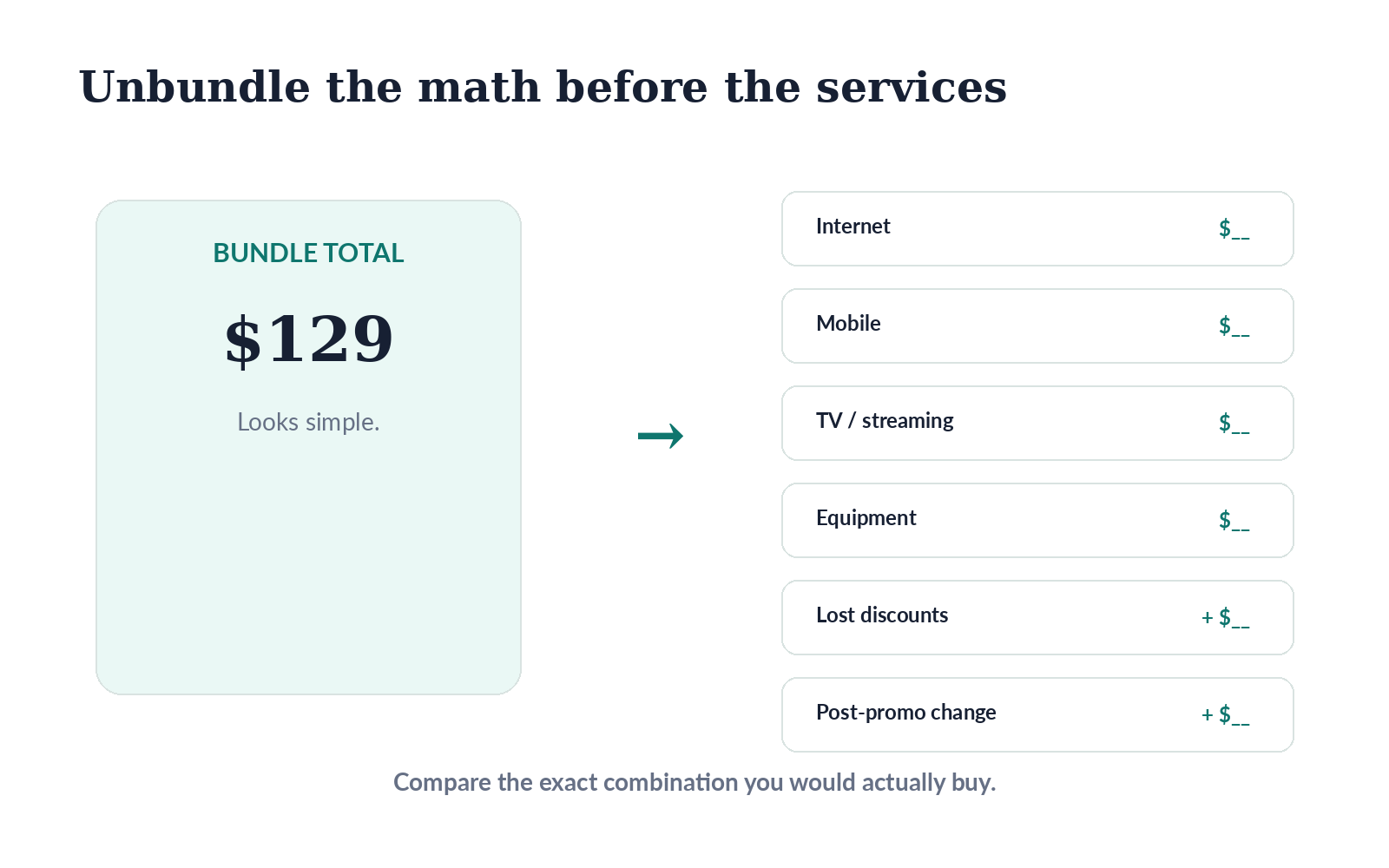
The wrong comparison is:
Bundle: $129 vs Internet: $70
Of course the bundle looks expensive when you compare three services with one.
The comparison that actually matters is:
Current bundle total
versus
standalone internet + replacement mobile plan + streaming you would actually buy + equipment + lost discounts
If the bundle is still cheaper, keep it.
If the bundle is more expensive, now you know how much convenience is costing you.
Watch the discount dependencies
Bundle math gets slippery at the discount dependencies.
A provider may give you $20 off internet because you also have mobile. Another discount may require autopay. A promotional rate may expire before the bundle discount. Equipment may be included only on a certain tier.
Ask one sentence before changing anything:
“If I remove this service, what will the monthly price of every remaining service become?”
Not “How much will I save?”
Those are not the same question.
“How much will I save?” invites a headline answer.
“What will every remaining service cost?” forces the new structure into the conversation.
The unused-service test
A bundle can be financially rational even when one service is rarely used.
That sounds wrong until you do the math.
Suppose internet alone would cost $90, while internet plus a basic phone line costs $85 because of a bundle promotion. You do not need to invent a use for the phone line. The bundle is simply the cheaper billing structure.
The reverse happens too.
You may be “saving $25” through a bundle while paying $60 for a TV package you would never buy on its own.
That is not a $25 savings.
It is a $35 extra expense wearing a discount badge.
The test is:
Would I buy each service separately if the bundle discount disappeared?
If not, calculate the package again without that service.
Post-promo math matters more than opening math
Bundles are often most attractive at signup.
Federal broadband-label law requires introductory-rate information for broadband offers, including the price after the introductory period.
Use that same mindset for the whole bundle.
Write two totals:
Today’s total
and
Known post-promo total
If the mobile line stays discounted for two years but the internet promo ends in twelve months, the package has more than one clock running.
A single “renewal date” is not enough.
Equipment can ruin a clean comparison
Do not forget boxes.
Gateway rental, mesh extenders, TV receivers, DVR service, mobile-device payments, and premium hardware can all sit outside the headline bundle price.
If you remove TV, do the receiver fees disappear? If you move internet tiers, is the gateway still included? If the mobile discount requires a financed phone line, what happens if you pay the device off?
You are not comparing marketing bundles.
You are comparing the next credit-card or bank-account charge.
Convenience has value too
There is a reason bundles survive.
One provider. One bill. One support number. Fewer logins. Fewer due dates. Sometimes real discounts.
If separating everything saves $7 a month but creates three accounts and a worse mobile plan, I would not call that an obvious win.
If separating saves $65 a month and removes a TV package nobody watches, the inconvenience starts looking affordable.
A personal threshold keeps that decision from turning into a vague debate.
Decide how much monthly savings makes a switch worth the setup time to you.
Do not copy someone else’s threshold. A household that hates changing providers will price hassle differently from someone who switches plans every year.
Before you change the bundle, ask these six questions
- What is my current total before taxes?
- Which discounts exist only because the services are bundled?
- What will each remaining service cost after I remove one?
- Does any contract, device payment, or early termination fee remain?
- Which equipment must be returned?
- When do the remaining promotions expire?
Get the answers in writing if possible.
Then calculate again.
Do not confuse the service bundle with the device balance
Mobile bundles can make this especially messy. The service discount and the phone financing are two different obligations, even when they appear on one bill. Before removing a line or moving a phone to another carrier, ask what happens to any remaining device balance, promotional device credits, trade-in credits, or installment plan.
The same principle applies to leased equipment and TV hardware: changing the service can trigger a return requirement even when the monthly bundle itself has no obvious cancellation fee.
Put those one-time costs next to the monthly savings. If unbundling saves $35 a month but creates a $420 immediate device payoff, the first-year math looks very different from the headline savings. That does not mean you should stay. It means the payoff belongs in the decision instead of arriving as a surprise afterward.
When bundles are genuinely good
A bundle can be the right choice when:
- you actively use most of the included services;
- the total is lower than realistic standalone alternatives;
- the discount lasts long enough to matter;
- the equipment and contract terms are acceptable;
- and the convenience is worth something to you.
You do not need to dismantle a good deal because “bundles are a trick.”
Sometimes the bundle is simply cheaper.
When the bundle is hiding overspending
Be more skeptical when:
- you cannot explain the price of each component;
- the promotional end dates are different;
- a service you barely use is the reason you feel “locked in”;
- removing one service changes several other prices;
- or the provider cannot give you a clear post-change total.
Confusing pricing does not automatically mean the deal is bad.
It does mean you should not change it until the math is clear.
Unbundle the math first
Do not ask whether bundles are cheaper in general.
Ask whether your bundle is cheaper than the exact combination of standalone services you would actually buy.
Unbundle the math first.
Then, if the numbers say to leave, you can unbundle the services without discovering the real price after the cancellation is already done.
Sources
- FCC – Broadband Consumer Labels compliance guide — reviewed/updated context: 2026
- 47 U.S.C. § 1753 – Adoption of consumer broadband labels — reviewed/updated context: August 19, 2026 laws-in-effect view
Last reviewed: August 25, 2026
Continue the cycle: Previous: The Bill Didn’t Get More Useful. It Just Renewed Higher. · Next: Annual Bill Negotiation Worksheet: Know Your Number Before You Call.