Why Did My Water Bill Jump? Don’t Blame the Rate Until You Check the Meter.
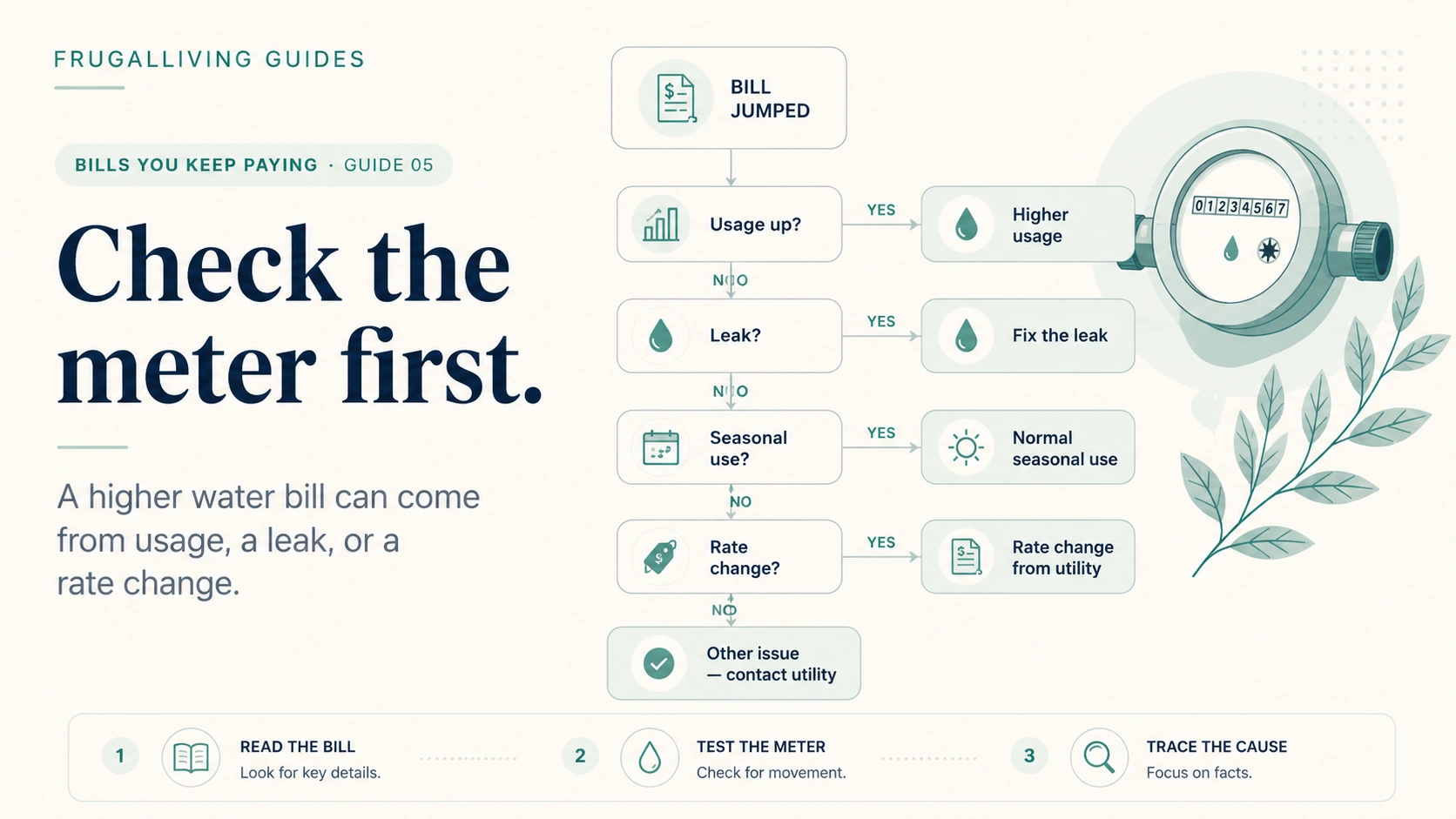
Before you panic: Compare water usage first, not just the dollar total. A higher bill can come from more gallons, more days in the billing cycle, a rate change, seasonal irrigation, or a leak. If usage jumped without an obvious reason, EPA WaterSense recommends checking the meter during a no-use period and testing common leak sources such as toilets.
A high water bill creates a very specific kind of suspicion.
You stare at the total and start mentally interrogating every shower taken in the house.
Sometimes the answer really is more water use. Sometimes it is a silent toilet leak. Sometimes the bill covered more days. Sometimes the rate changed and your gallons did not.
Do not start by guessing.
Start by separating price from usage.
Step 1: compare gallons or CCF, not dollars
EPA WaterSense recommends using the bill itself to understand how much water the household used and how that use changed over time. Utilities commonly measure in gallons or CCF/HCF, where one CCF equals 748 gallons.
Look at this month’s usage and compare it with:
- last month;
- the same month last year;
- the household’s winter baseline if you have outdoor watering;
- and the number of billing days.
If the dollar amount jumped but usage stayed about the same, the problem may be the rate structure, fixed charge, sewer charge, or billing period.
If usage jumped, start looking for where the water went.
That distinction can save an hour of crawling under sinks for a leak that does not exist.
Step 2: check the billing period
Thirty-one days is not twenty-eight days.
A delayed meter read, estimated bill, move-in adjustment, or longer billing cycle can make one bill look dramatic even when daily use barely changed.
Divide usage by the number of billing days if the bill provides both.
That gives you a rough daily-use comparison.
A bill with 10 percent more usage over 10 percent more days may be boring. A bill with 40 percent more usage over the same number of days deserves attention.
Step 3: check whether the rate changed
Water bills are often a mix of fixed and variable charges. EPA WaterSense notes that many utilities use a base fee plus a volume charge, and some rate structures change seasonally or by usage tier.
Read the “billing detail” rather than only the amount due.
Look for:
- base service charge;
- water usage charge;
- sewer charge;
- stormwater or other utility charges;
- seasonal pricing;
- higher usage tiers;
- new local fees.
If the utility publishes current rates online, compare them with the previous period.
The meter cannot explain a rate increase.
Before the leak hunt, make sure you are reading the right total
Some bills combine more than the water itself. Depending on the local utility, the statement may include wastewater or sewer charges, fixed service charges, stormwater items, or other local fees. A higher total does not prove that the price per gallon changed.
That is why usage belongs at the top of the diagnosis. If gallons or CCF are flat but the dollar total jumped, inspect the rate lines and fixed charges before crawling under sinks. If usage itself jumped, then the meter and leak checks become much more useful.
If the bill is hard to decode, call the utility and ask one concrete question: “Which line changed from my last normal bill?” That is usually faster than asking why the whole bill is high.
Step 4: do the no-use meter test
If usage rose and nobody can explain why, this is the most useful test in the article.
EPA WaterSense suggests checking the water meter before and after a period when no water is being used. Its consumer guidance uses a two-hour no-use period; if the meter changes, you probably have a leak.
Turn off faucets. Do not run the dishwasher or washing machine. Make sure irrigation is not scheduled. Avoid flushing toilets during the test.
Take a photo of the meter reading. Wait. Check again.
If the meter moved, stop arguing about shower length. You have evidence that water went somewhere.
Step 5: test toilets before opening walls
Toilets are boring leak suspects, which is exactly why they are good suspects.
A worn flapper can let water move from tank to bowl without making a dramatic puddle on the floor.
WaterSense recommends putting a few drops of food coloring in the toilet tank and waiting about ten minutes. If color appears in the bowl without flushing, the toilet is leaking. Flush afterward so the coloring does not stain.
Test every toilet.
The leak you cannot hear is often more expensive than the faucet drip you can.
Step 6: look outside
If the spike happened in warm weather, check irrigation before assuming the plumbing failed.
Look for:
- sprinkler heads watering the sidewalk;
- broken drip lines;
- irrigation running more days than expected;
- a controller reset after a power outage;
- hose bibs left dripping;
- pool filling;
- new landscaping;
- unusually hot or dry weather.
Outdoor water use can dwarf indoor changes.
If you have a separate irrigation meter or a smart irrigation controller, check its history.
Step 7: think about “invisible” household changes
Not every jump is a leak.
Houseguests, school breaks, working from home, filling a pool, pressure washing, washing a car, new laundry routines, or a new appliance can move usage enough to show up on the bill.
A better question than “Did we use more water?” is:
It is “What changed during this exact billing period?”
Put the bill dates next to the calendar. Memory gets much better when it has dates to work with.
How much can leaks matter?
EPA WaterSense says the average household’s leaks can account for more than 9,300 gallons of wasted water per year, and fixing easily corrected household leaks can save homeowners about 10 percent on water bills.
Those are national program estimates, not a prediction of your bill.
A single household can be far below or far above them.
Use the meter and your own usage history to decide whether you actually have a leak problem.
When to call the utility
Call the water provider when:
- usage seems impossible based on the meter or household pattern;
- you suspect an estimated or incorrect meter read;
- you do not understand a new charge;
- the meter is inaccessible or damaged;
- you fixed a leak and want to ask whether the utility has a leak-adjustment policy;
- or you need help interpreting the rate structure.
Some utilities offer leak alerts or high-use notifications. If yours does, turn them on.
A text message during the leak is more useful than a surprise bill thirty days later.
When to call a plumber
If the no-use meter test shows movement and you cannot find the leak, the problem may be in a line, fixture, water heater, irrigation system, or another place that is not obvious.
WaterSense also notes that leak-detection and flow-monitoring devices can identify irregular water use or moisture and, in some systems, trigger automatic shutoff.
Do not buy a smart shutoff valve because one bill looked weird.
But if your house has recurring leaks, aging plumbing, long periods when nobody is home, or high water-damage risk, monitoring can be worth evaluating.
The order that matters
A high water bill is a diagnostic problem before it is a budgeting problem.
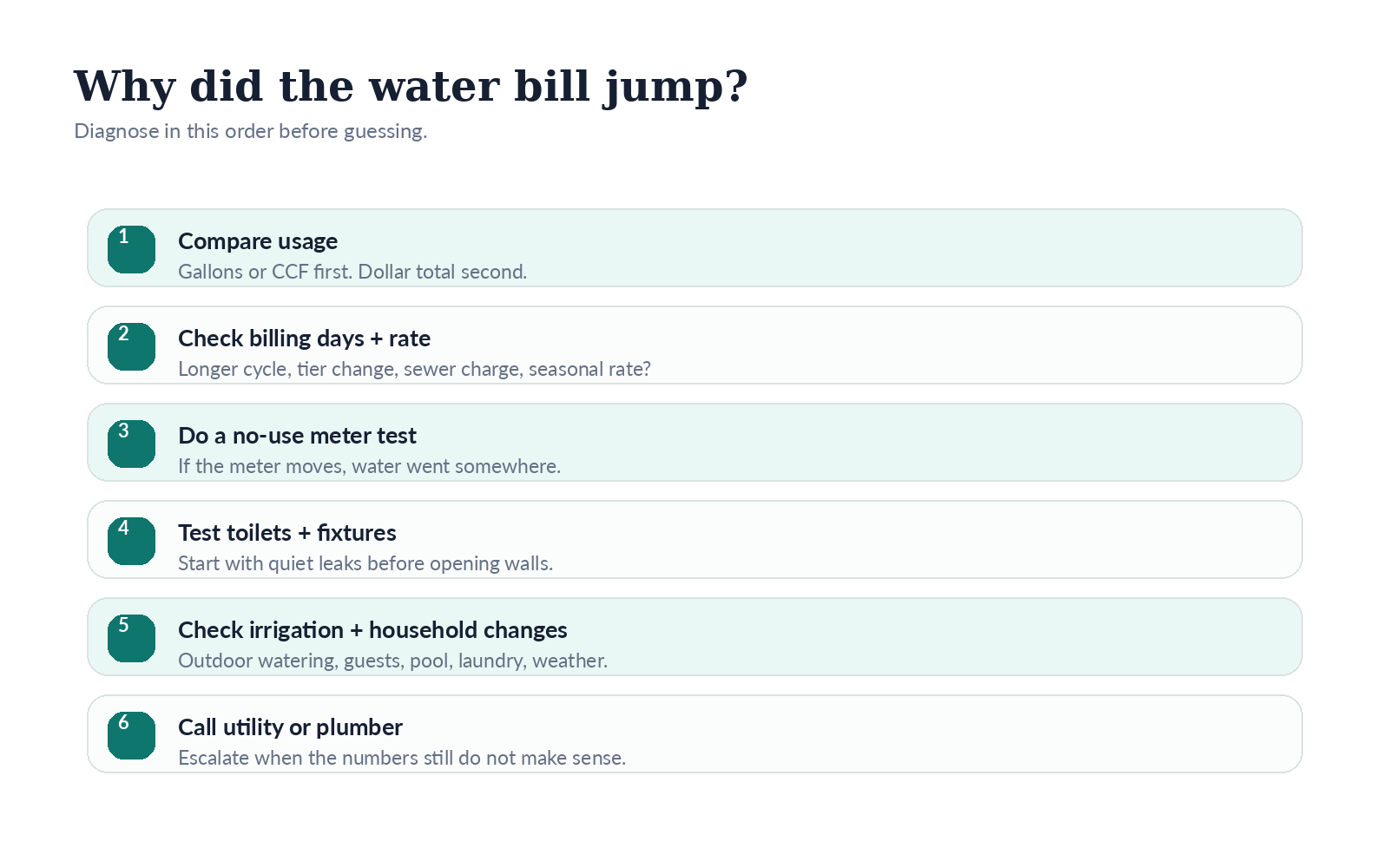
Compare usage. Check billing days. Check the rate. Test the meter. Test the toilets. Look outside.
That order gets you from “this bill is ridiculous” to an actual explanation much faster.
Sources
- EPA WaterSense – Understanding Your Water Bill — reviewed/updated context: 2026 access
- EPA WaterSense – Fix a Leak Week — reviewed/updated context: March 13, 2026
- EPA WaterSense – Leak Detection and Flow Monitoring Devices — reviewed/updated context: February 27, 2026
Last reviewed: August 25, 2026
Continue the cycle: Previous: Fixed or Variable Electricity Rate? Choose the Risk You Can Live With. · Next: The Bill Didn’t Get More Useful. It Just Renewed Higher.