Your Electronics Are Still Using Power While “Off”
“Off” does not always mean zero. Standby loads can account for a noticeable share of home electricity use, and the wrong rate plan can add another layer of waste. Neither problem requires living in the dark — just checking the defaults.
You beat the supermarket by out-designing the room. The utility bill is the same fight on a battlefield you can’t see. It arrives whether you were careful or not, and most people assume the number is just “what it costs.” It isn’t. Some of it may be standby consumption you rarely notice.
Standby: paying to keep things asleep
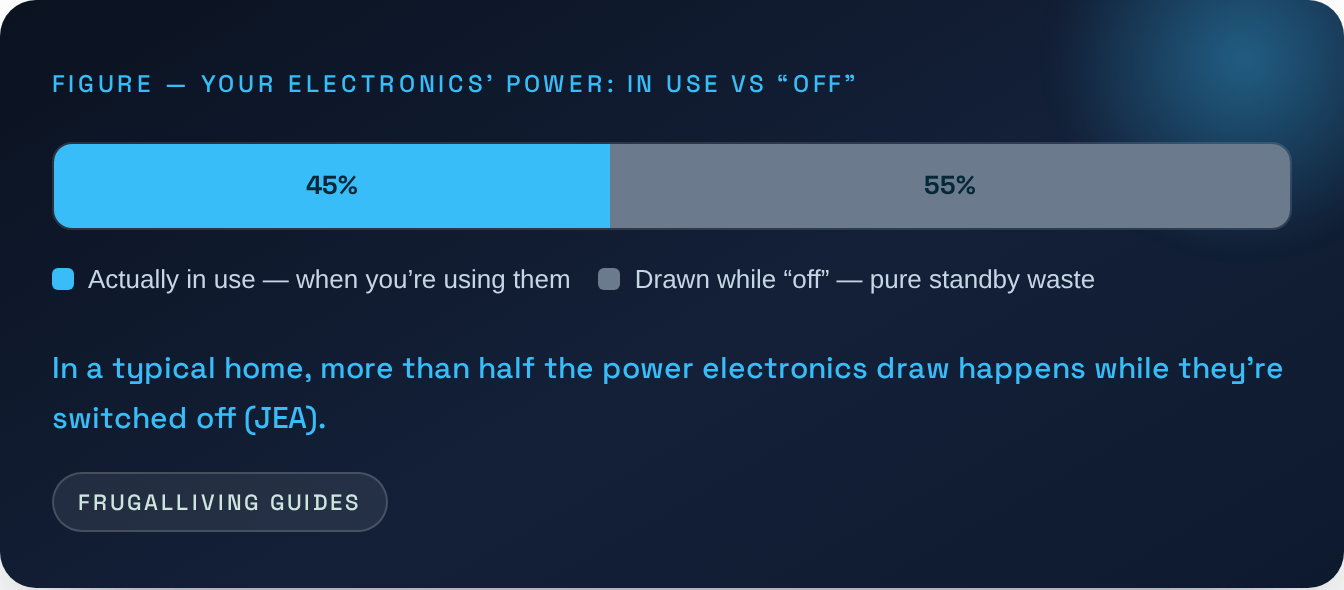
Many modern electronics continue drawing some power in standby mode. It drops into standby — listening for a remote, holding a clock, keeping a network link warm. Individually each draw is tiny. Collectively, running 24 hours a day, 365 days a year, that standby draw can add up. U.S. Department of Energy guidance, citing Lawrence Berkeley National Laboratory, says products drawing power while idle can approach 10% of residential electricity use in a typical home.
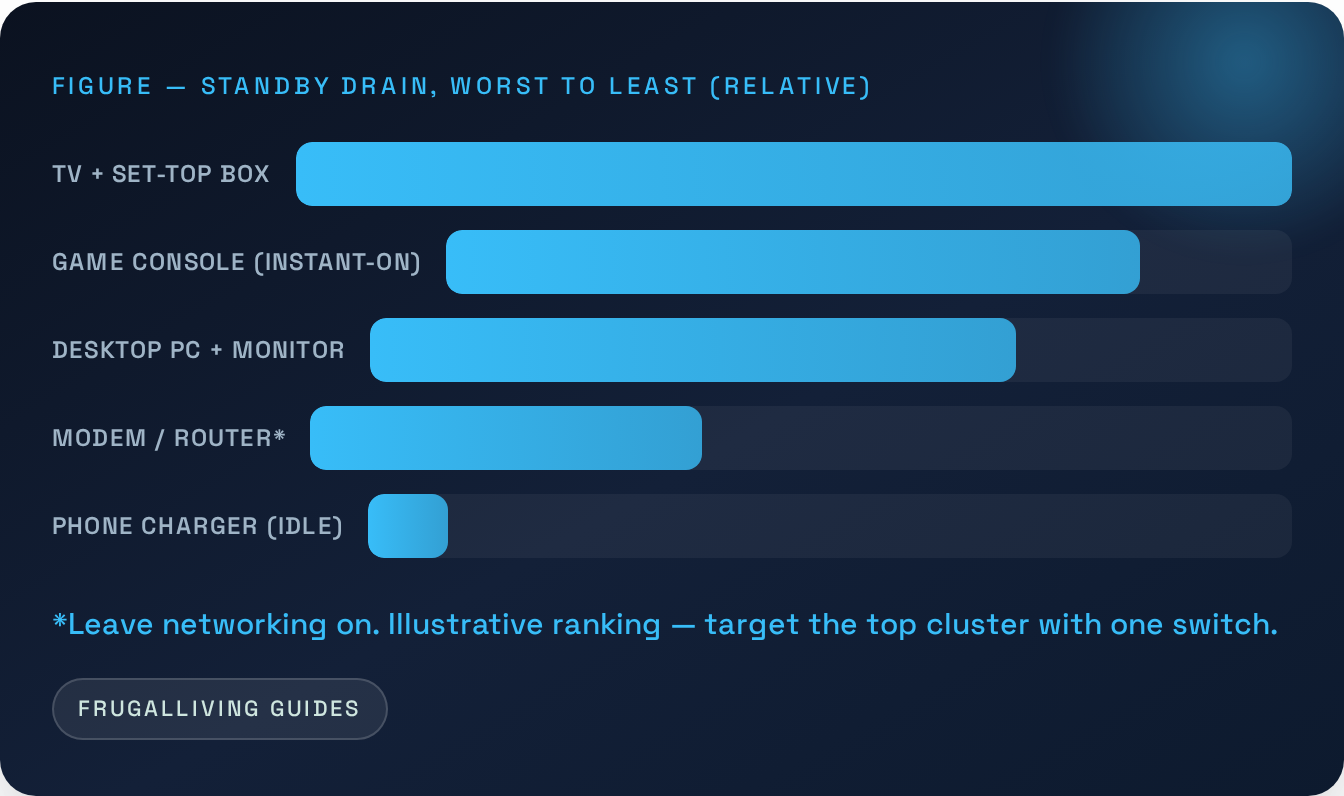
The biggest standby loads are usually worth finding rather than guessing. Entertainment equipment, networked devices and hardware with quick-start modes can draw more than a simple charger. If you want certainty, a plug-in power meter tells you what a device is actually using.

Which sleeping devices bleed the most
You don’t need to unplug the house. Aim at the few heavy phantom draws and ignore the rest — this is the 80/20 of standby. Put the worst clusters on a single switchable power strip and cut them all at once at night or when you leave.
The mismatch that overcharges you silently
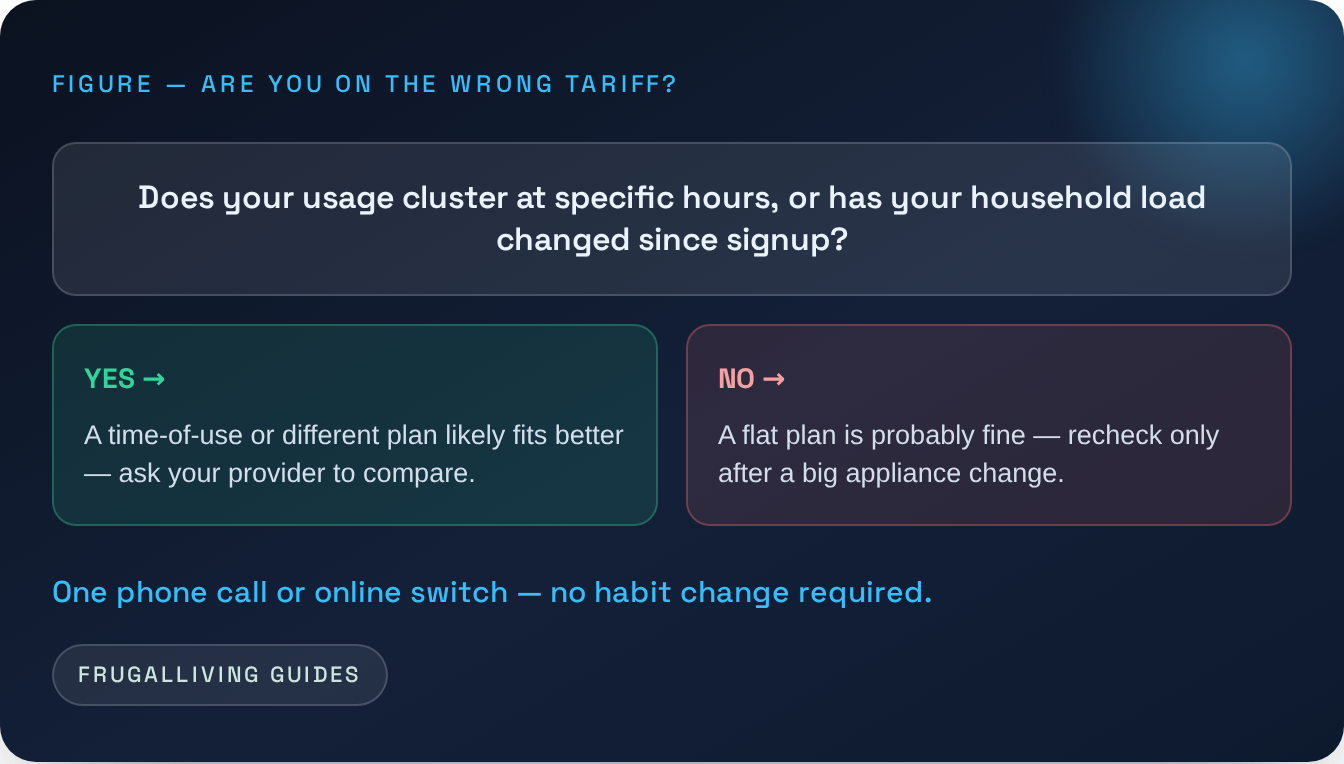
The second hidden leak isn’t a device — it’s the plan. Some utilities offer multiple rate structures, including time-of-use plans. Whether another plan saves money depends on the rates available where you live and when you use electricity. If your usage is concentrated at certain hours, or you’ve added or dropped major appliances since you signed up, you may be on a structure that bills you for a pattern you no longer have.
You can’t fix what you haven’t checked. Pull one recent bill and look for two things: the tariff/plan name, and whether there’s a time-of-use option you’re not on. Then ask the one question that decides it:
Measure before you start unplugging chargers
Standby power is real, but not every glowing LED deserves your attention.
A plug-in electricity meter can tell you how much a device or power strip actually draws. Test the clusters most likely to matter: entertainment equipment, desktop setups, network hardware, printers, game consoles, and older devices with instant-on modes.
Then do the annual math:
watts × hours per day × 365 ÷ 1,000 = kWh per year
Multiply by your electricity rate.
That turns a spooky “phantom load” into a number you can compare with the inconvenience of switching it off.
Keep the hierarchy straight
Standby is one layer of the bill.
Heating, cooling, water heating and large appliances can dominate household electricity use. If your home has an inefficient HVAC system, poor insulation, electric resistance heating, or an old water heater, spending an hour hunting tiny adapters may be the wrong first project.
The useful order is:
- check major loads and obvious equipment problems;
- check the rate plan;
- then clean up worthwhile standby clusters.
Frugality is prioritization, not unplugging everything that has a cord.
Time-of-use plans can save or cost money
A time-of-use plan charges different prices depending on when electricity is used. That can reward households that move large loads away from expensive periods.
It can also backfire if the household cannot shift much.
Before switching, look at:
- the exact on-peak hours;
- seasonal rate changes;
- weekend rules;
- whether heating/cooling runs during expensive periods;
- when an EV, dryer or dishwasher can realistically run;
- any minimum term or enrollment condition.
Do not switch because “off-peak is cheaper.” Compare the entire pattern.
Create a 30-minute annual utility review
Once a year:
- compare 12 months of usage, not just dollars;
- check for a sudden usage jump;
- confirm the current rate/tariff;
- review major appliance settings;
- test suspicious standby clusters;
- note any home change that could explain the bill.
If usage climbs without an obvious reason, investigate before assuming the utility simply raised prices.
Turn it into a set-and-forget system
Like every fix on this site, the win is structural, done once:
- One switchable strip for the worst standby cluster (entertainment center is usually it). Off at night, off when away.
- Disable “instant-on” / quick-start on consoles and TVs in settings — a menu toggle, permanent effect.
- Right-size the tariff once a year, and after any big appliance change.
- Let the big loads do the heavy lifting: heating, cooling, and hot water dwarf gadgets — a small setpoint change there beats unplugging fifty chargers.
The practical fix
Start with the measurable stuff: identify devices with meaningful standby draw, disable quick-start modes you do not value, and compare the rate plans your utility actually offers. The savings may be modest or meaningful depending on the household — but once the right settings are in place, they keep working without daily effort.
Next in this series → You May Be Paying for Data You Never Use — compare your plan with your actual usage before the next renewal.
Part of the larger guide: Why You Can’t Save Money — And the System That Fixes It.
Continue the money-saving cycle
- Previous: The Grocery Store Is Making Decisions With You
- Next: You May Be Paying for Data You Never Use
Sources & further reading
- Lawrence Berkeley National Laboratory, Standby Power — https://standby.lbl.gov/
- U.S. Department of Energy, home energy guidance — https://www.energy.gov/energysaver/energy-saver
- Standby estimates describe aggregate household/device behavior; actual savings depend on the devices, hours, local electricity rate and household usage.