Fixed or Variable Electricity Rate? Choose the Risk You Can Live With.
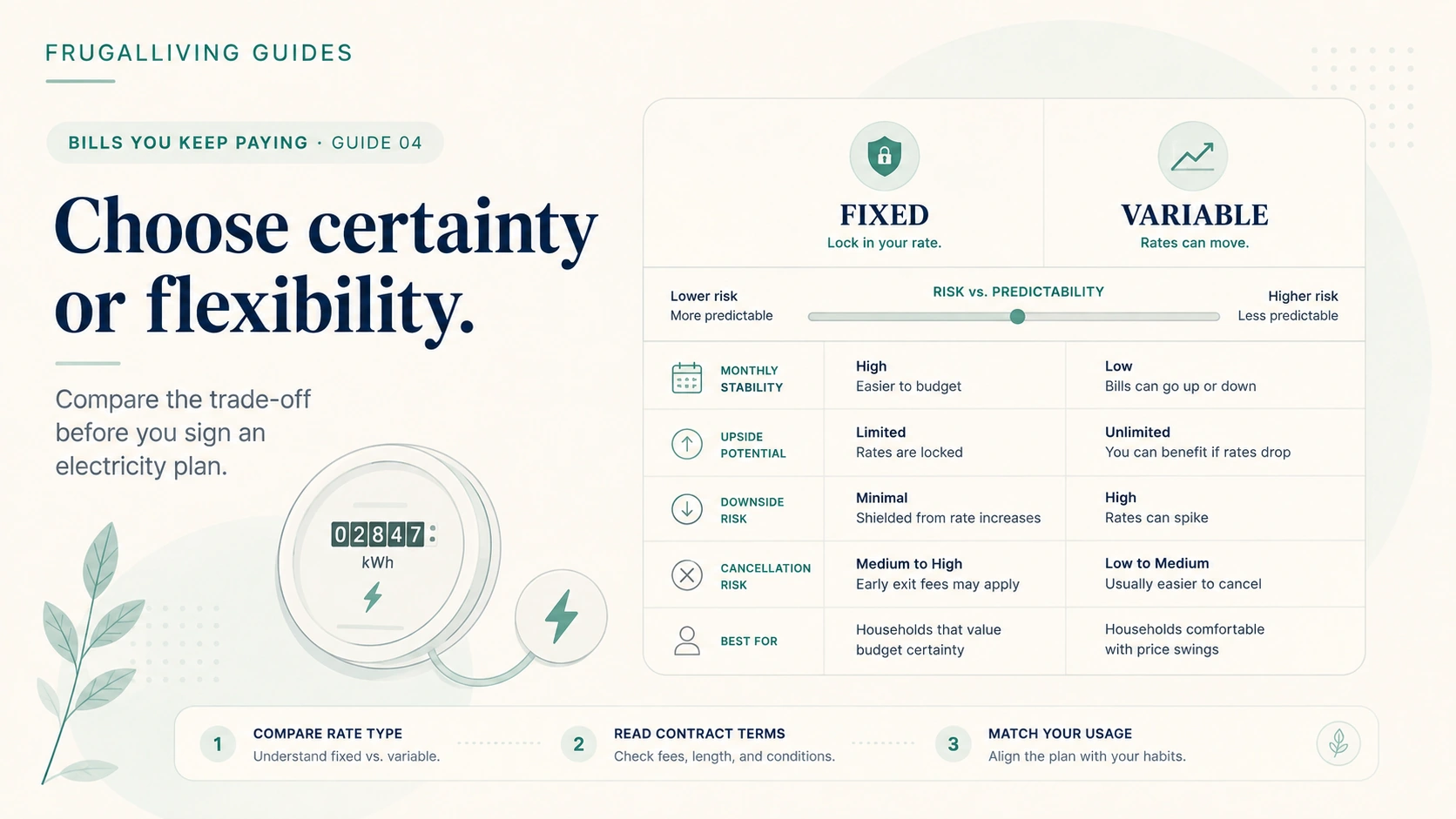
Quick verdict: In retail-choice markets, a fixed supply rate usually buys price certainty for a contract period, while a variable rate can move from month to month. “Fixed” does not necessarily freeze every line on the bill, and “variable” is not automatically cheaper. Compare the supply rate, delivery charges, contract length, cancellation terms, and your actual usage.
The cheapest electricity plan on the screen today is not necessarily the cheapest plan for the year.
That is the whole problem.
A variable rate can look attractive in a calm month. A fixed rate can look expensive right before market prices fall. And the word “fixed” can give people more confidence than the contract actually deserves.
If you live in a market where residential customers can choose an electricity supplier, asking only “Which rate is lower?” misses the real decision.
It is “Which kind of price risk do I want to carry?”
First check whether you actually have retail choice
Electricity markets are not uniform across the United States. In some areas, the local utility supplies and delivers electricity under regulated rates. In others, customers may be able to choose a competitive supplier for the energy portion while the local utility still handles poles, wires, delivery, and outages.
The Department of Energy notes that rate options and supplier choice depend on state and utility structure.
So before comparing plan types, confirm that the offers you are seeing apply to your address and identify which part of the bill is actually changing.
What “fixed” usually means
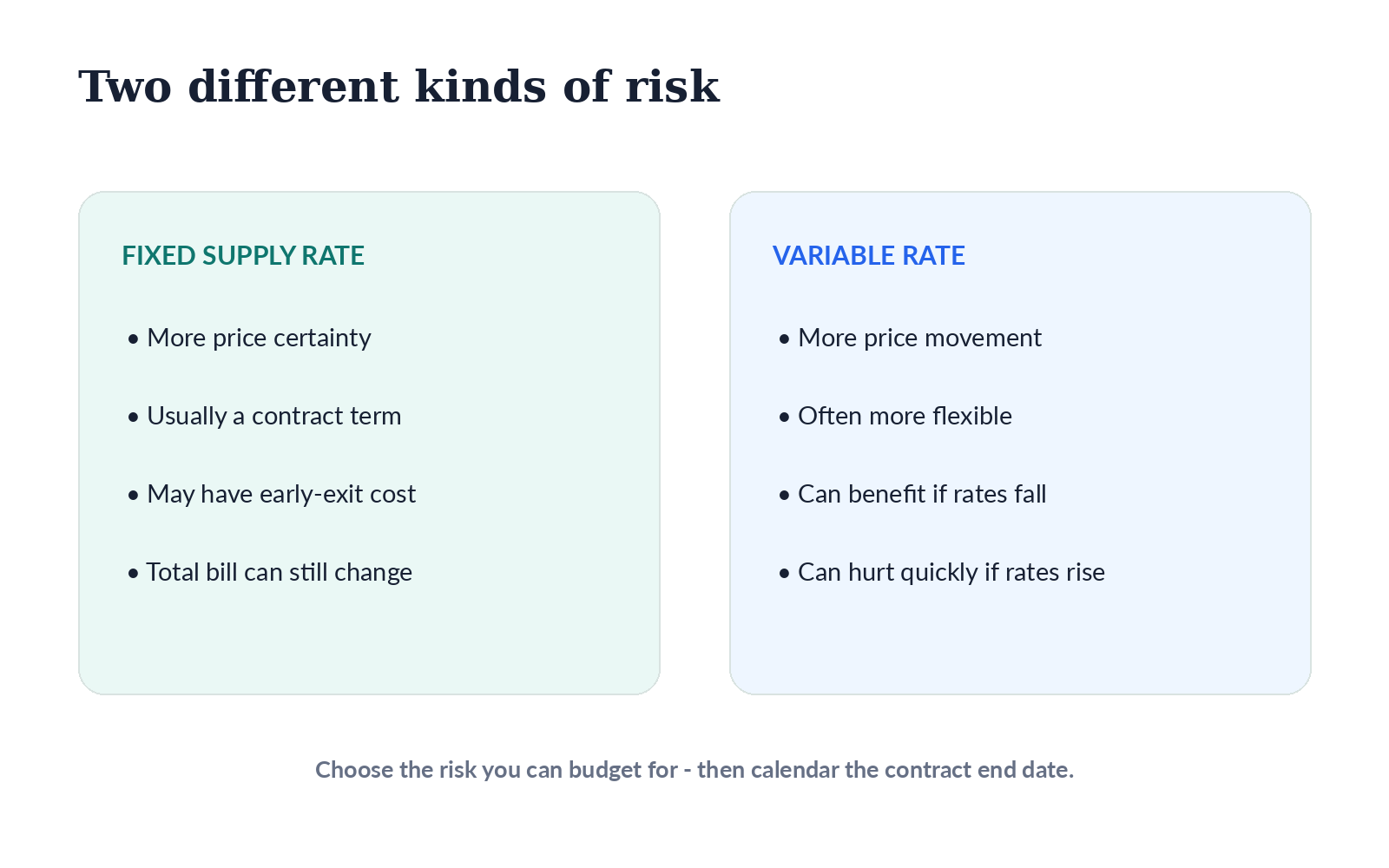
The Public Utility Commission of Texas describes fixed-rate plans as plans where the retail provider’s price does not change during the contract period, subject to specified exceptions such as certain transmission and distribution charges or changes tied to laws and grid-related fees.
That nuance matters.
A fixed supply rate can make the energy-price portion more predictable. Your total bill can still rise because you used more electricity, delivery charges changed, taxes changed, or another allowed charge moved.
Fixed does not mean “same bill every month.”
It means a defined part of the price has less exposure to market movement for a period of time.
What “variable” means in practice
Variable-rate plans generally do not lock the supply price for a long contract term. The rate can move from month to month based on market conditions and the provider’s pricing structure.
That flexibility cuts both ways.
If market prices fall, you may benefit sooner than someone locked into a fixed contract. If prices spike, your bill can react before you have time to shop around.
New York’s Department of Public Service similarly explains that variable supply prices can change monthly, while fixed rates stay the same for a specified period.
The trade-off is simple even when the bill is not:
Fixed shifts more price risk to the provider for the contract period. Variable leaves more of that risk with you.
The decision is easier when you know your usage
Do not compare only cents per kilowatt-hour.
Pull twelve months of bills if you have them. Look at your highest-use months, not just the average.
A one-cent difference per kWh barely matters in a low-use month and matters more when air conditioning or electric heat pushes usage up.
Illustrative example
At 800 kWh per month, a 2-cent difference in the energy rate equals about $16 for that month.
At 1,800 kWh, the same 2-cent difference equals about $36.
That is not a prediction of savings. It is a reminder that your usage multiplies the rate difference.
A plan that looks cheap for a 500-kWh example household may not be cheap for yours.
Compare the plan at your own usage, not the sample usage
Electric plans are often advertised with example bills or average prices at specific usage levels. Your home may not live anywhere near that example.
Pull several months of actual kWh usage – ideally enough to include both a mild month and a high-use heating or cooling month. Then apply the plan’s supply rate and any recurring charges to those numbers. If the plan has tiered pricing, credits, or time-of-use periods, a single “average cents per kWh” figure can hide how the bill behaves at your level.
You are not trying to forecast the energy market. You are checking whether the plan that looks cheap on the comparison page is still cheap in your house.
A plan that wins at 1,000 kWh but loses badly at 500 or 1,800 kWh may be a poor fit for a household with strong seasonal swings.
Read the contract length like it is part of the price
A fixed rate often comes with a term. That term can create an early termination fee or limit how quickly you can benefit if market prices fall.
A variable plan may offer more flexibility but less certainty.
Write down:
- contract start and end dates;
- fixed, variable, or indexed plan type;
- supply price or pricing formula;
- early termination fee;
- minimum usage fee or credit, if any;
- time-of-use periods, if any;
- delivery charges that remain outside the supplier rate;
- what happens when the contract expires.
The renewal term matters almost as much as the opening rate.
A good one-year fixed plan that rolls into an expensive month-to-month rate can become a bad plan if you forget the end date.
Be careful with plans that are not really “fixed vs variable”
Some offers use indexed pricing, time-of-use rates, bill credits, free nights, minimum-usage thresholds, or other structures.
Those are not simple fixed-versus-variable decisions.
The Department of Energy notes that time-variable pricing can change based on hour and season, and some market structures reflect wholesale prices more directly.
If the plan has a clever name, ignore the name for a minute.
Ask how the bill is calculated at your actual usage pattern.
If you cannot reproduce the basic math from the plan documents, the plan is harder to evaluate than it should be.
When fixed is the safer choice
A fixed rate tends to make more sense when:
- predictable monthly budgeting matters a lot;
- your usage is high during seasons when prices can be volatile;
- the contract rate is competitive;
- the cancellation terms are acceptable;
- and you are willing to set a reminder before the term ends.
“Safer” here means safer for your budget, not guaranteed cheapest.
That is the trade-off worth naming.
When variable can make sense
A variable rate may fit better when:
- you need flexibility and do not want a long contract;
- you are willing to watch rates;
- the provider’s pricing method is clear;
- your usage is modest enough that short-term rate movement is manageable;
- or you are between homes or waiting for a better long-term offer.
Variable rates are not automatically reckless. They simply ask you to tolerate more uncertainty.
When this advice does not apply cleanly
If your local utility does not offer supplier choice, you may still have different utility rate structures such as time-of-use or seasonal pricing. That is a different comparison.
If you have rooftop solar, battery storage, electric-vehicle charging, electric heat, or a demand-based rate, the timing of usage can matter more than the simple fixed-versus-variable label.
And if an offer includes “free” hours, bill credits, or usage tiers, test it against your actual 12-month pattern before treating the advertised average price as your price.
The one-page test
Before enrolling, you should be able to answer these five questions on one sheet of paper:
- What is the energy rate or formula?
- Which charges can still change?
- How long am I committed?
- What happens when the term ends?
- What would this plan have cost at my own high-use month?
If you cannot answer those, keep reading before you click enroll.
Choose the risk, not the label
Fixed versus variable is not a personality test.
Fixed buys more certainty and may cost you flexibility. Variable buys more flexibility and leaves you exposed to price movement.
Choose the risk you understand, then put the contract-end date on your calendar so a good plan does not quietly become a bad one later.
Sources
- Public Utility Commission of Texas – Types of Electric Plans — reviewed/updated context: 2026 publication
- New York Department of Public Service – How to Shop for Energy Services — reviewed/updated context: 2026 access
- U.S. Department of Energy – Evaluating Your Utility Rate Options — reviewed/updated context: April 28, 2026 update
Last reviewed: August 25, 2026
Continue the cycle: Previous: Your Checking Account Is Charging Rent. Start Here. · Next: Why Did My Water Bill Jump? Don’t Blame the Rate Until You Check the Meter.