Your Internet Bill Went Up. Make This Call Before You Switch.
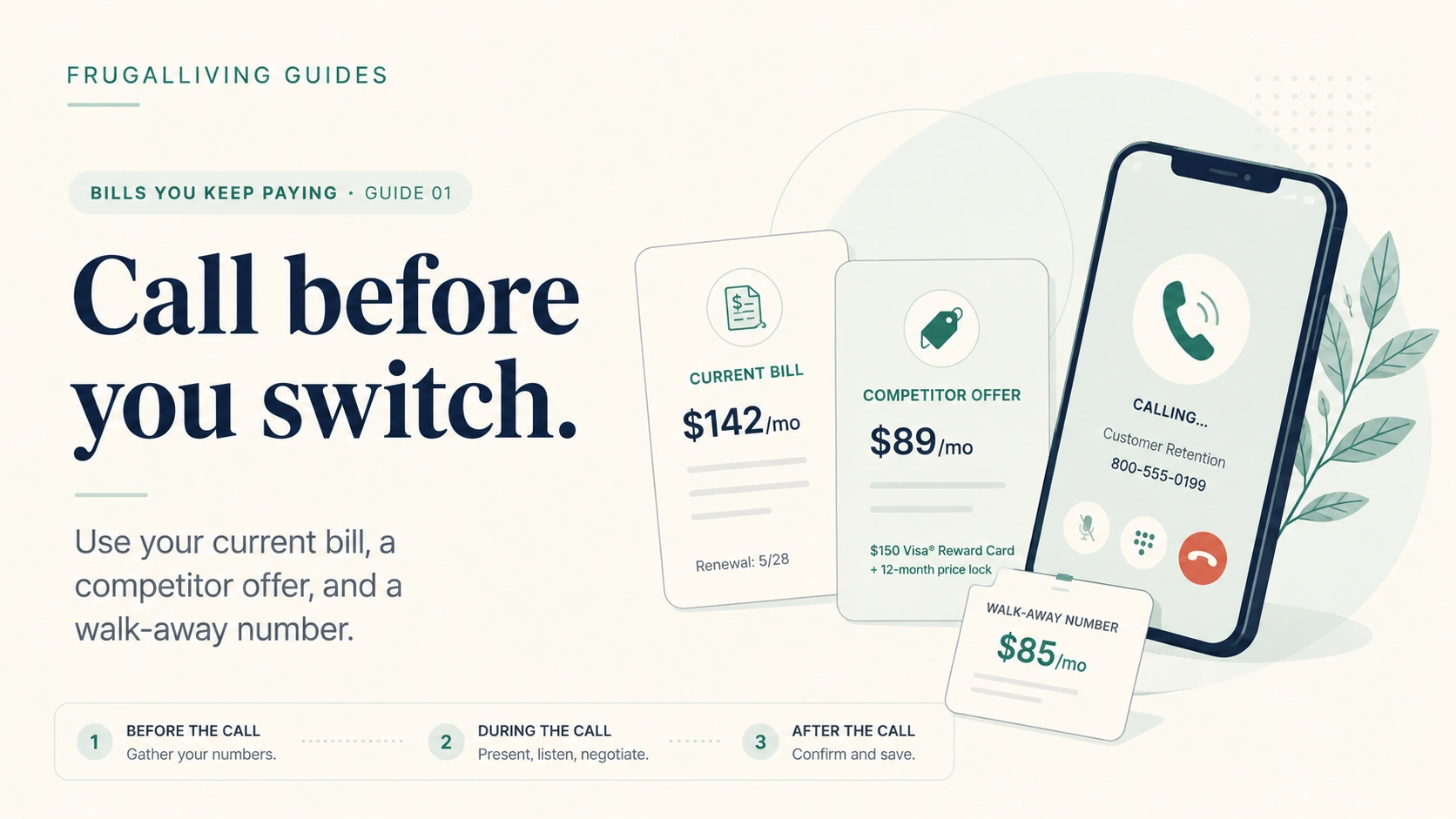
Quick answer: Do not start by threatening to cancel. Start by finding your current plan’s real non-promotional price, the post-promo rate, equipment charges, and one comparable offer available at your address. Then call with one specific ask: lower the monthly total without losing the speed or features you actually use.
The annoying part is not that your internet bill went up. It is that your internet did not get any better.
Same router. Same living room dead spot. Same speed test you only run when something feels slow. Then one month the bill quietly moves from “annoying but fine” to “why am I paying this much?”
That is the right time to call. But calling with no plan is how a five-minute job turns into hold music, vague discounts, and a new package you did not ask for.
Start with the bill, not the customer-service number
Before you call, open your latest bill and write down the monthly total you actually pay. Not the advertised price. Not the number you remember from when you signed up.
Separate these pieces if your bill shows them:
- base internet service;
- equipment rental or gateway charge;
- add-ons such as security, extra Wi-Fi equipment, or premium support;
- autopay or paperless-billing discount;
- promotional credit;
- taxes or provider-imposed fees;
- and any bundle discount tied to mobile, TV, or phone service.
Then find the FCC Broadband Facts label for the plan, if your provider displays it online for your address. Federal law requires broadband consumer labels to identify whether a price is introductory and, if so, the price that follows the introductory period. FCC label rules also make pricing and plan terms easier to compare across offers.
That label is useful because it gives you a cleaner baseline than a banner ad shouting “starting at $X.”
Find one real alternative before you negotiate
You do not need a spreadsheet with twelve providers. You need one credible alternative.
Check what another provider will actually sell at your address, at a speed you would genuinely accept. Save the page or take a screenshot. Note whether the price requires autopay, a mobile line, a long contract, or new-customer status.
The point is not to bluff.
The point is to know whether your current provider is asking you to pay $85 for something another company will sell you for $60 – or whether the market around you is expensive and there is no easy escape.
That changes the conversation.
Pick your number before you call
Most people make the call harder right here.
Decide three numbers:
Current monthly total: what leaves your account now.
Target monthly total: the number that would make staying feel reasonable.
Walk-away total: the price above which you will seriously consider switching, downgrading, or removing extras.
A target is not the same thing as “give me your best deal.” A specific number makes it easier to judge an offer while you are on the phone.
Illustrative example
Suppose your bill is $92 and a comparable competitor plan is $65 for the first year, rising later. You might decide that $72 to $75 is good enough to avoid an installation appointment and equipment swap.
That is not a universal savings threshold. It is a convenience price you choose for yourself.
If the representative offers $78, you now have a decision. Without a target, $78 just sounds lower than $92 and you may say yes before checking the trade-off.
What to say when someone answers
Keep it boring.
“I’m reviewing my monthly bills. My internet total is now $92, and I have a comparable offer available at my address for less. I’d prefer to stay if you can get my monthly total closer to $75 without reducing my current service. What options do you have?”
That sentence does four useful things. It says you know your number. It gives the representative a reason for the call. It makes clear that you are open to staying. And it prevents the conversation from drifting immediately into an upsell.
If the first answer is “there are no promotions available,” ask whether there is a customer-retention, loyalty, or plan-review option. Providers use different department names, so do not get hung up on the label.
You are trying to reach someone who can review current offers on the account.
Do not let a lower headline price hide a worse deal
A representative may find something cheaper. Good. Now slow down for thirty seconds.
Ask:
- What will my total monthly price be before taxes?
- How long does that price last?
- What does the price become after the promotion?
- Does this require autopay or a specific payment method?
- Am I changing speed, data allowance, or contract terms?
- Is equipment included or charged separately?
- Does accepting this restart a contract or create an early termination fee?
- Will any other discount on my account disappear?
A cheaper headline can still backfire: you “save” $10, add a mobile line you did not need, accept a price that jumps six months later, or pick up a different equipment charge.
A lower first number is not enough. You want the new monthly structure.
If the provider offers a speed downgrade
Do not reject it automatically.
A lot of households pay for a speed tier because it sounded future-proof when they signed up. That does not mean the lower tier will feel different in ordinary use.
But do not downgrade blindly either. Think about simultaneous users, large uploads, work-from-home needs, cloud backups, gaming latency, and whether your current plan is masking a weak Wi-Fi setup.
If the only way to save $20 is to move from a tier you never use to one that still covers your household, that may be a better result than chasing a temporary loyalty credit.
The goal is not to “win” the phone call. The goal is to stop overpaying for capacity or extras you do not value.
When negotiating probably will not help much
Some markets have one realistic high-speed provider. Rural areas can have limited alternatives. Apartments may restrict wiring or available services. You may also be in a legacy plan that is cheaper than anything currently advertised.
In those cases, the competitor-price tactic has less leverage.
Your better moves may be:
- removing equipment or add-ons you do not need;
- checking whether you qualify for a lower-cost plan;
- moving to a lower speed tier;
- using customer-owned equipment if it is compatible and makes financial sense;
- or simply setting a reminder for the next promotion or contract-end date.
That last one matters. A bad time to negotiate is not proof that the bill can never change.
Get the new deal in writing
Before you hang up, ask the representative to send confirmation by email or through your account portal.
Save it.
Then put one date on your calendar: the month before the discount expires.
This small step is what keeps a successful negotiation from turning into the same surprise bill twelve months later.
If your internet bill is not the only recurring charge creeping upward, the bigger fix is to track renewal dates across the household instead of rediscovering each increase after it happens. We will build that system later in this series.
Make the call with numbers, not nerves
A good internet-bill call is not dramatic. It is prepared.
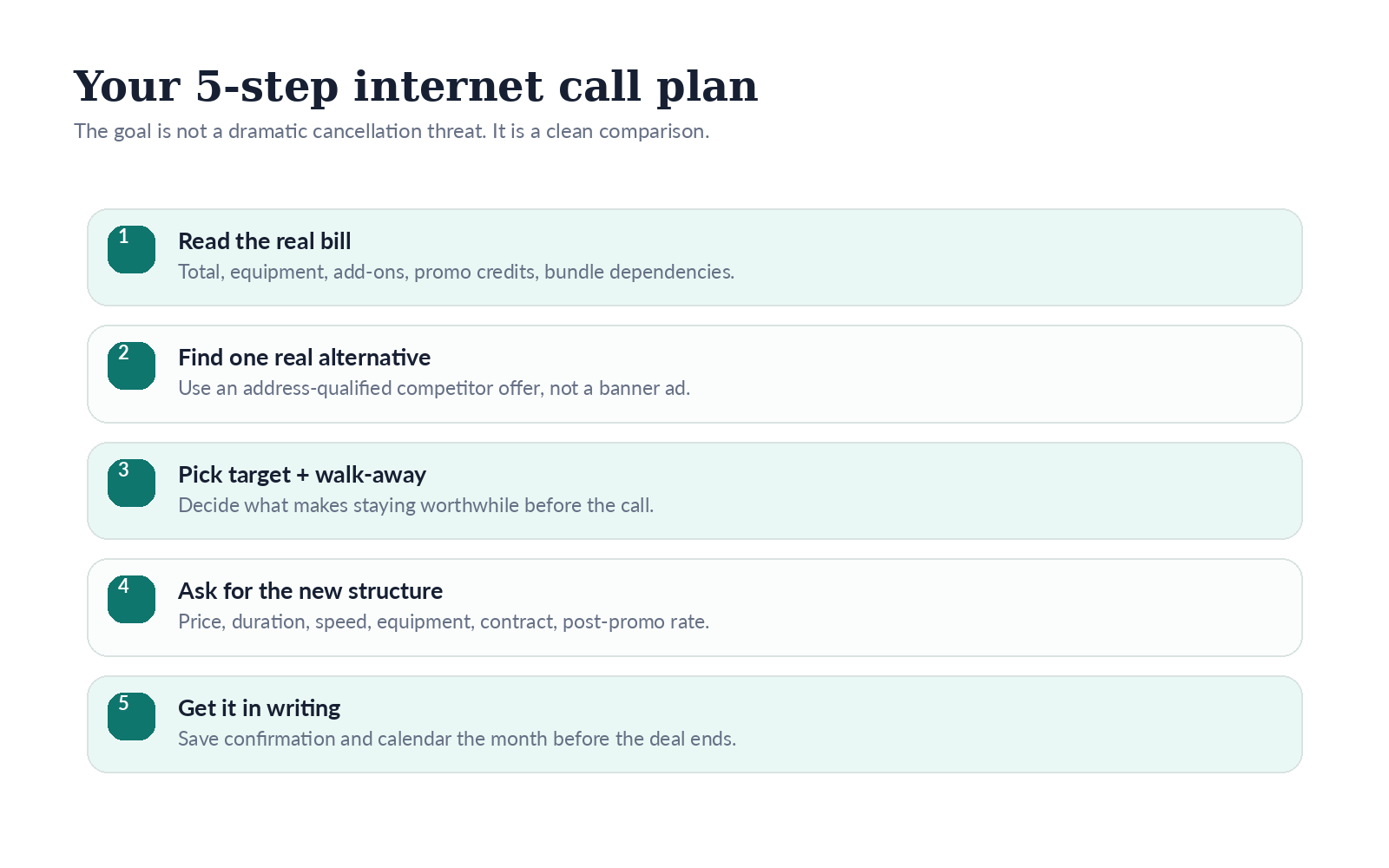
Know what you pay. Know what a real alternative costs. Pick the number that makes staying worthwhile. Ask what changes with the new offer. Get the terms in writing.
You can do all of that before the hold music finishes its second loop.
Sources
- 47 U.S.C. § 1753 – Adoption of consumer broadband labels — reviewed/updated context: August 19, 2026 laws-in-effect view
- FCC – Broadband Consumer Labels compliance guide — reviewed/updated context: 2026
Last reviewed: August 25, 2026
Continue the cycle: Previous: How to Reduce Utility Bills Without Chasing Tiny Savings · Next: Rent the Router or Buy Your Own? Do the Math Before You Decide.