Annual Bill Negotiation Worksheet: Know Your Number Before You Call.
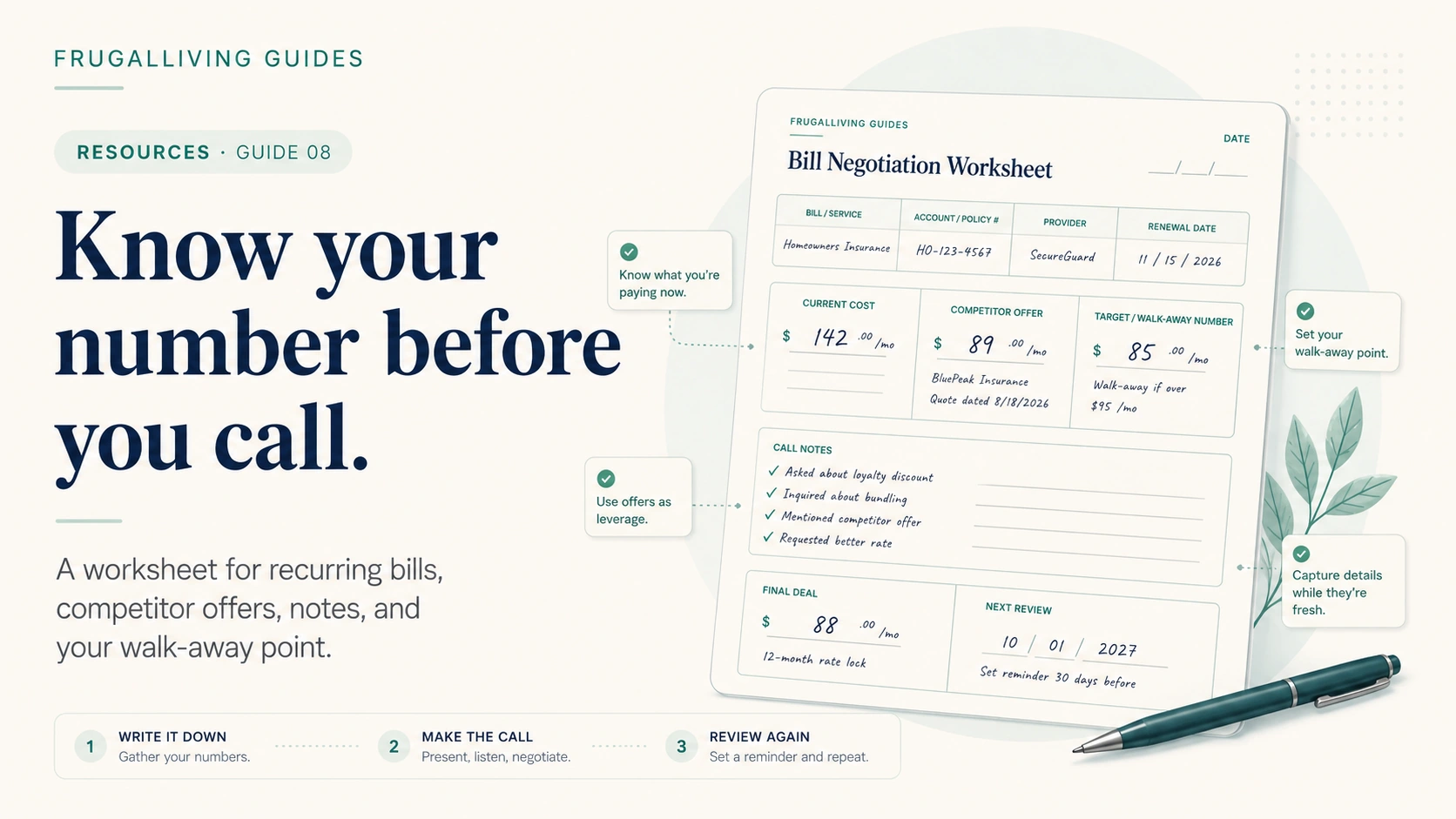
Free field guide: Use this worksheet for internet, phone, insurance, memberships, and other recurring bills that are expensive enough to review. It gives you one place to record the current cost, competing offer, target number, call notes, final deal, and next renewal date so the same bill does not surprise you again next year.
Calling a company with nothing in front of you is how you end up accepting a “deal” you cannot explain five minutes later.
The representative is talking. You are trying to remember what the competitor charged. There is a new equipment fee. The discount lasts “for a while.” You say yes because the total sounds lower.
This worksheet is designed to stop that.
It is not a giant household budget planner. It is a call sheet for one recurring bill at a time.
What the worksheet helps you decide
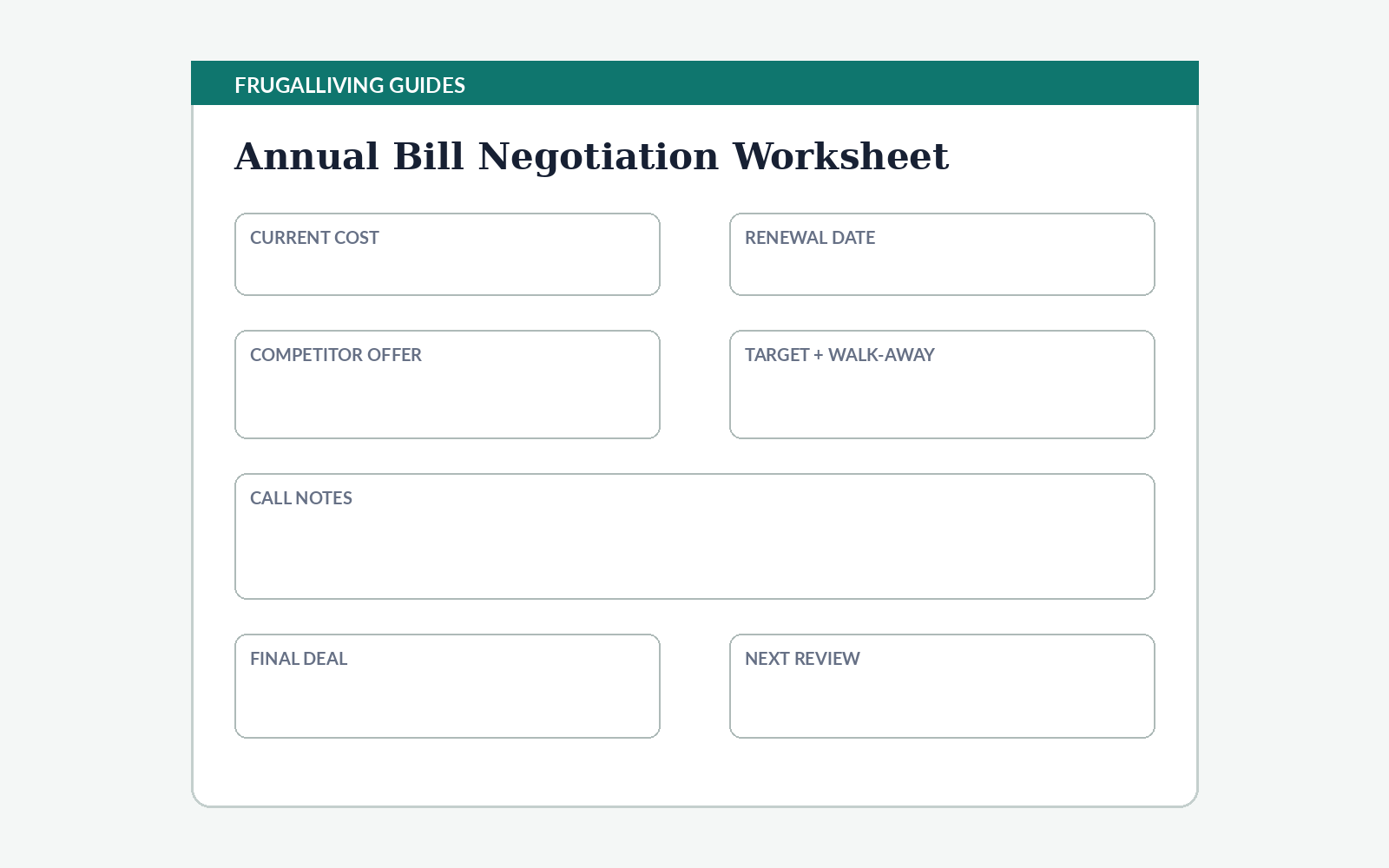
Before the call, you write down:
- the current monthly or annual cost;
- what part of the price is promotional;
- the renewal or promotion-end date;
- the service level or coverage you want to keep;
- one credible competing offer;
- your target price;
- and your walk-away number.
During the call, you have space for the representative’s name, offer details, fees, contract terms, and what changes after the promotion.
After the call, you record the final monthly cost, annualized savings, confirmation number, and the next review date.
That last field is the reason this is an annual system rather than a one-time coupon hunt.
Use the target and walk-away boxes differently
Your target is the number that would make you happy to stay.
Your walk-away number is the point where the price is high enough that you will seriously compare switching, downgrading, or removing extras.
Those numbers do not have to be far apart.
They also do not need to represent the theoretical cheapest offer on the internet.
If changing providers saves $8 a month but requires equipment returns, an installation visit, and two hours of your time, you may decide the convenience of staying is worth some money.
Write that decision down before the call.
It is much easier to protect a boundary you chose calmly than one you invent while someone is waiting for your answer.
The competitor box needs a real offer
Use an offer available at your address or for your situation whenever possible.
Record:
- advertised price;
- regular or post-promo price;
- required autopay or bundle;
- contract length;
- equipment cost;
- and any setup or cancellation cost you can identify.
The worksheet is not asking you to prove another company is perfect.
It is giving you a reference point.
Do not skip the “what changes?” line
A lower price is only useful if you know what changed to create it.
The new offer may:
- reduce speed;
- raise the deductible;
- remove a feature;
- add a contract;
- depend on autopay;
- require another service;
- or expire sooner than you expect.
Write the trade-off next to the price.
If there is no trade-off, great. If there is one, you can decide whether the savings are real for you.
Calculate annual savings only after the deal is clear
The worksheet includes a simple annualized savings line:
Old recurring cost – new recurring cost = monthly savings
Monthly savings × 12 = annualized savings
For annual bills, compare the annual totals directly.
This is a planning number, not a guarantee. A promotional rate can expire, taxes can change, and usage-based bills can move.
The point is to put the result in a scale your brain can feel.
Saving $14 a month sounds modest. Saving $168 over a year may make the twenty-minute call feel more worthwhile.
Which bills belong on this worksheet?
Use it when the cost is meaningful enough that a review could matter.
Good candidates include:
- internet;
- mobile service;
- insurance renewal reviews;
- home security;
- paid memberships;
- software used by the household;
- storage plans;
- some utility-supply contracts in retail-choice markets;
- and other recurring services with a negotiable or replaceable price.
Do not turn every $4 subscription into a negotiation project.
Sometimes the correct action is simply cancel or keep.
This worksheet is for bills where comparison and conversation can change the outcome.
Download the worksheet
Print version: A4 and US Letter
I made two print sizes so the form works cleanly without scaling tricks.
US Letter: for standard U.S. home printers.
A4: for international printers and anyone who keeps A4 paper on hand.
Both versions use high-contrast black-and-white styling, minimal ink-heavy fills, generous writing areas, and the same field order.
The downloadable Field Guide is two pages: Before the Call and During / After the Call. That gives the writing spaces enough room to be useful instead of squeezing everything into tiny boxes just to claim it fits on one page.
Make the next review date non-negotiable
A successful call can still fail twelve months later if you forget when the new price ends.
Before you put the worksheet away, enter the next review date into your phone or calendar.
Do not rely on finding the paper again.
The paper records the decision. The calendar makes sure you revisit it.
One sheet, one decision
Know your current number. Know the competitor number. Know the number that makes staying worthwhile.
Then make the call.
That is enough structure to keep a routine bill review from turning into an hour of confusion – and enough documentation to make next year’s call much easier.
Last reviewed: August 25, 2026
Continue the cycle: Previous: Bundles Feel Cheaper Because the Expensive Part Is Harder to See. · Next: How to Save Money on Groceries Without Buying Less Food