The Bill Didn’t Get More Useful. It Just Renewed Higher.
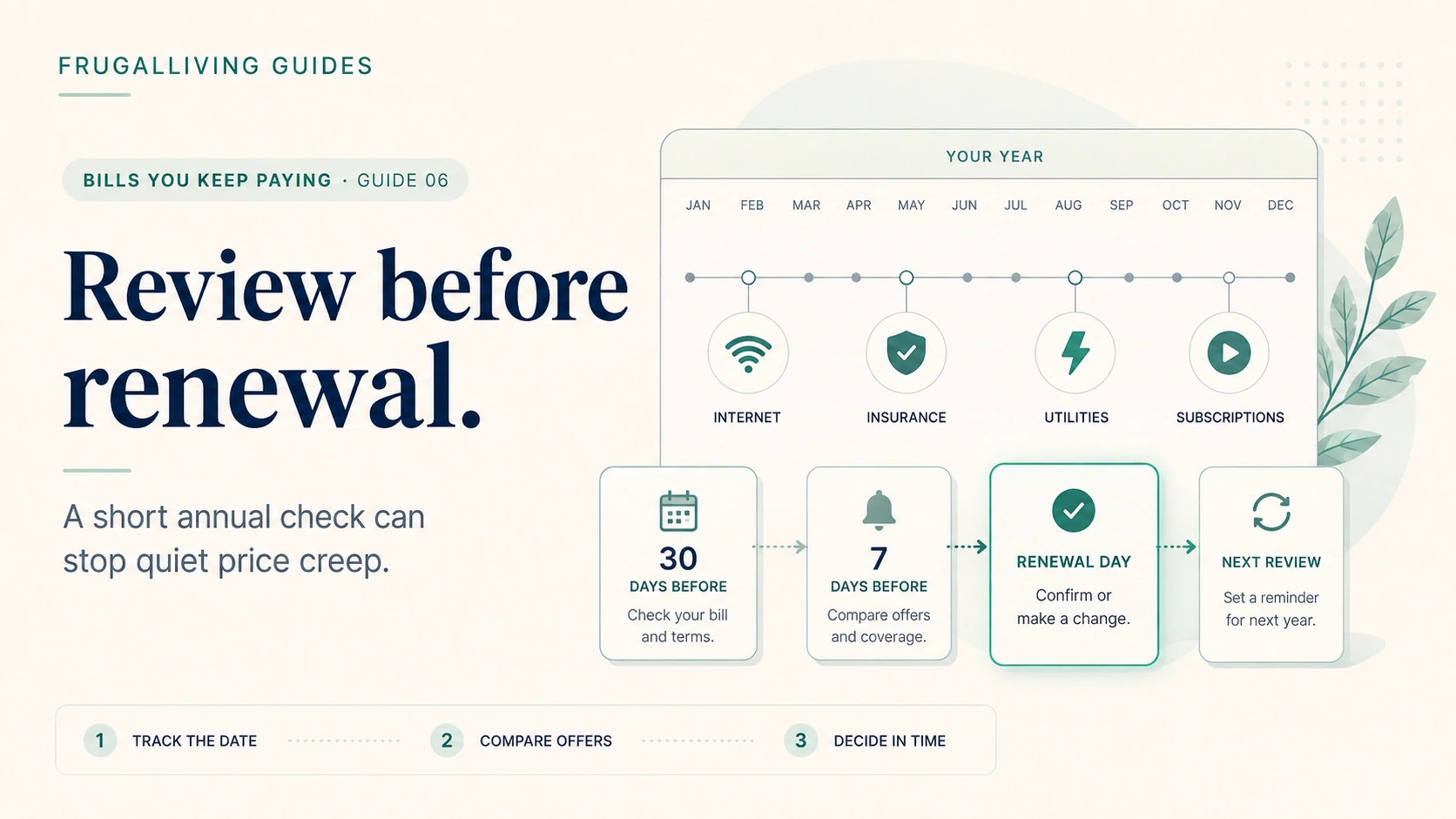
The useful fix: Do not wait for a higher charge to remind you that a promotion or contract ended. Track renewal dates, post-promo prices, cancellation windows, and annual review dates in one place. Review each bill before the deadline, not after the new price hits. Cancellation rights and renewal laws vary, so keep the contract and confirmation instead of assuming every service follows the same rules.
Some bills go up because the underlying cost changed.
Others go up because a date arrived.
Your internet promotion expired. The annual software plan renewed. The insurance policy rolled into another term. A membership that felt cheap at $49 became $79 while you were busy doing literally anything else.
The charge is not hidden. The date is hidden from your attention.
That is the annual renewal trap.
The problem is not autopay
Autopay is useful. It prevents late payments and removes boring admin work.
The problem is using autopay without a review date.
A recurring charge can be perfectly legitimate and still become a bad deal because:
- the introductory price ended;
- the standard price increased;
- your usage changed;
- the service became redundant;
- a bundle discount disappeared;
- your household no longer needs the same coverage or plan;
- or a competitor now offers something better.
Autopay keeps the bill moving. Your calendar has to keep the decision moving.
Promotions deserve their own date
Broadband is the cleanest example.
Federal broadband-label law requires the label to say whether the offered price is introductory and, if it is, what price follows the introductory period.
So “$50 a month” is only half the number you need.
It is:
$50 until March 2027 → then $75.
When you sign up, put March 2027 on the calendar immediately. Better yet, put February 2027 on the calendar so you can compare before the increase.
The same habit works for promotional credit-card rates, storage plans, domain renewals, software, home-security offers, and discounted memberships.
You do not need to distrust the promotion.
You need to remember the second price.
Annual subscriptions need a “would I buy this again?” test
Annual billing is psychologically sneaky because it disappears for eleven months.
A service can feel free for most of the year and then suddenly hit the card for $119.
Thirty to forty-five days before renewal, ask one question:
If I did not already have this, would I buy it today at the renewal price?
If the answer is yes, renew and move on.
If the answer is “maybe,” check usage.
If the answer is no, cancel before the deadline and save the confirmation.
That is a cleaner decision than asking whether you “might use it more next year.”
Insurance is a review, not an automatic cancellation
Insurance renewals belong on the calendar, but they need a different response from a streaming subscription.
Do not cancel coverage because the premium rose.
Use the renewal as a trigger to verify limits, deductibles, discounts, major life changes, and comparable quotes. Then make sure any replacement coverage is active before ending the old policy.
The renewal date is a maintenance date.
Not a panic button.
Do not assume there is one universal cancellation rule
Subscription and automatic-renewal law is messy.
The FTC’s broad 2024 “click-to-cancel” rule was later vacated by a federal appeals court, and the FTC opened a new negative-option rulemaking process in 2026. At the same time, the agency continues to bring enforcement cases alleging deceptive subscription, renewal, and cancellation practices under existing law.
States can also have their own automatic-renewal requirements.
For a household system, the practical takeaway is simple:
Do not build your savings plan around the assumption that cancellation will always be one click or that every service must send the same reminder.
Read the terms. Keep the confirmation. Start early.
Automatic payment and cancellation are not the same thing
This distinction matters when money comes directly from a bank account.
The CFPB explains that consumers can revoke authorization for automatic debits and can work with their bank to stop future automatic payments. But stopping an automatic payment does not necessarily cancel the underlying contract or erase money you still owe.
So if you are leaving a service:
- cancel the service or contract through the company;
- save the cancellation confirmation;
- change or revoke automatic payment if needed;
- watch the next statement.
Do not confuse “the debit stopped” with “the account is closed.”
Build one renewal calendar, not six reminder systems
You do not need a new app.
A simple spreadsheet, calendar, or printable page is enough.
For every recurring bill with a meaningful renewal or price-reset date, track:
- service name;
- current price;
- renewal or promotion-end date;
- expected next price if known;
- cancellation deadline;
- contract end date;
- payment method;
- action: keep, compare, negotiate, cancel, or review.
Set the reminder 30 to 45 days before the date when possible.
That gives you time to compare instead of reacting after the charge.
The best review window depends on the bill
Not every bill needs the same lead time.
A streaming service may take five minutes to cancel.
Insurance deserves enough time to compare coverage carefully.
Internet service may require a phone call, equipment return, or installation appointment with a competitor.
A domain name or professional software subscription may be easy to renew but costly to lose accidentally.
Your reminder should match the friction of changing.
The more annoying the switch, the earlier the reminder.
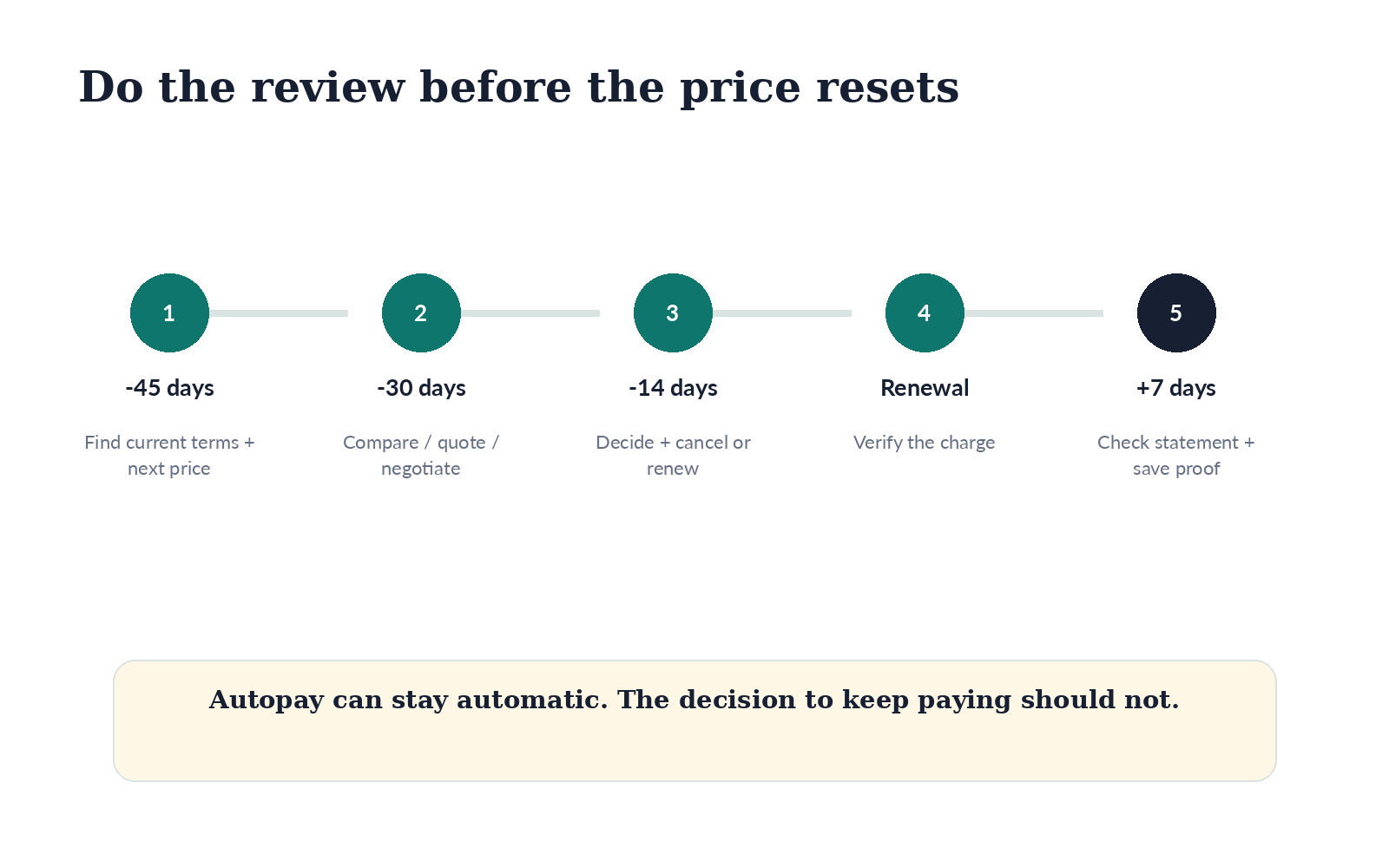
Use a 45 / 30 / 14-day rhythm for the bills that matter
You do not need three reminders for every $6 subscription. Use the heavier system for bills where a bad renewal can cost real money or take time to unwind.
About 45 days out: find the renewal notice, current contract, or post-promo price. Decide whether the bill is worth reviewing.
About 30 days out: compare one or two realistic alternatives and note any cancellation window, equipment return, or coverage handoff that could slow the change.
About 14 days out: make the call, switch, cancel, or deliberately keep the service. Save the confirmation.
The dates are a planning template, not a legal deadline. Contracts and state rules can use different notice periods, so the actual terms win. The point is simply to move the decision far enough ahead that “I ran out of time” stops being the reason you renewed.
What if the renewal price is still reasonable?
Then do nothing.
This system is not designed to make you renegotiate every bill every year.
It is designed to make “do nothing” an active decision instead of an accident.
If a service costs $70, you use it constantly, the price is competitive, and switching would waste an afternoon, keeping it can be the frugal choice.
Frugality is not a contest to produce the smallest possible bill.
It is paying on purpose.
Put the date where you can see it
The most expensive renewal is the one you did not know was coming.
Put the dates in one place. Review before the deadline. Compare only when the bill is worth the effort. Save confirmation when you change something.
A recurring payment should be automatic.
The decision to keep paying it should not be.
Sources
- 47 U.S.C. § 1753 – Adoption of consumer broadband labels — reviewed/updated context: August 19, 2026 laws-in-effect view
- CFPB – How do I stop automatic payments from my bank account? — reviewed/updated context: December 22, 2025
- FTC – Shutterstock subscription and cancellation settlement — reviewed/updated context: May 2026
- FTC – Negative Option Rule / 2026 rulemaking status — reviewed/updated context: 2026
Last reviewed: August 25, 2026
Continue the cycle: Previous: Why Did My Water Bill Jump? Don’t Blame the Rate Until You Check the Meter. · Next: Bundles Feel Cheaper Because the Expensive Part Is Harder to See.