Your Checking Account Is Charging Rent. Start Here.
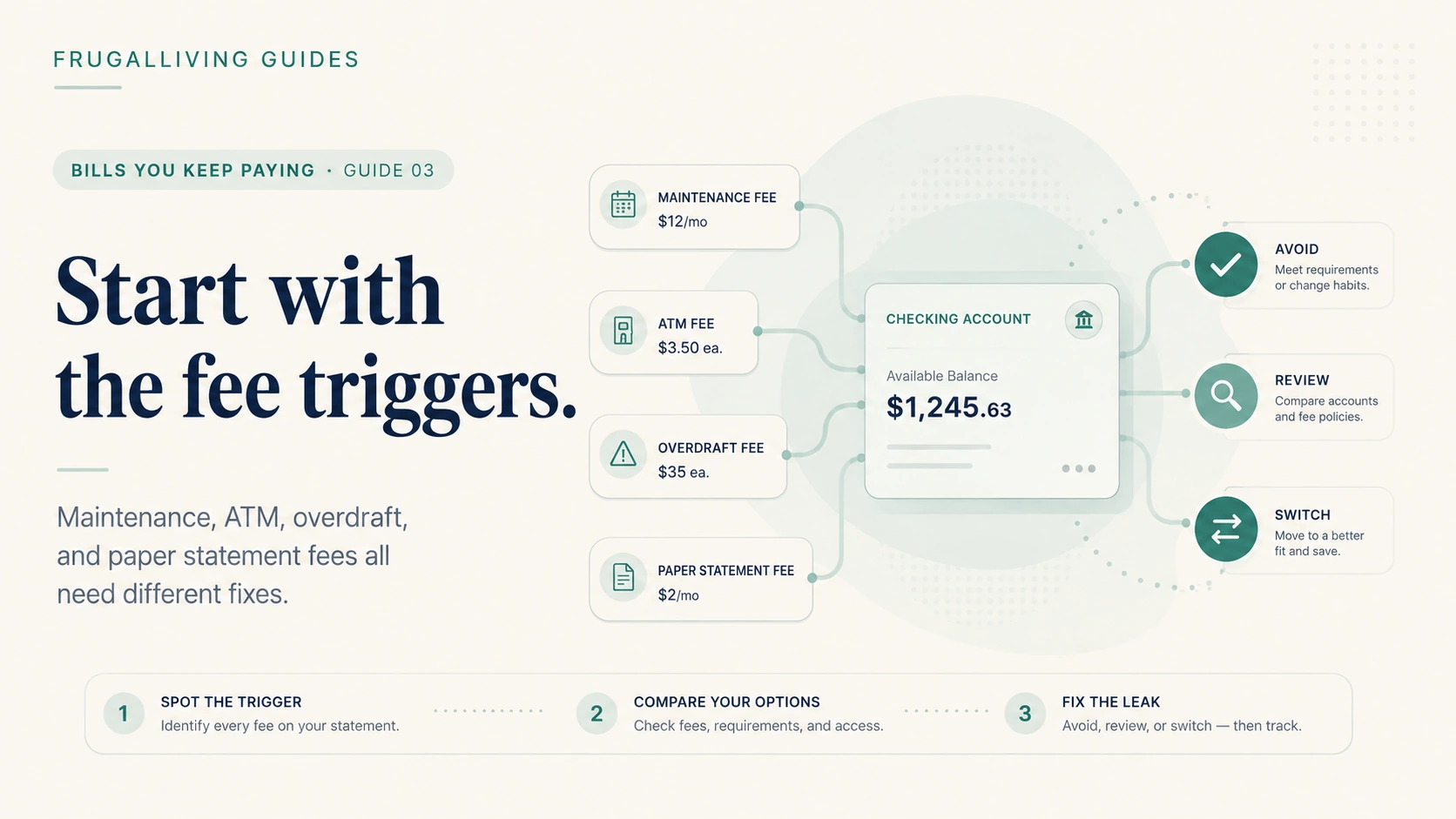
Start here: Pull the last three statements and total every fee before changing banks. Monthly maintenance is often avoidable by meeting account conditions or choosing a different account. Overdraft rules are more specific: ATM and one-time debit overdraft fees generally require opt-in, while checks and recurring electronic payments can be treated differently.
A $10 monthly account fee is $120 a year for the privilege of already having your own money there.
That sentence is satisfying. It is also incomplete.
Some bank fees are easy to avoid. Some are tied to choices you made when the account opened. Some happen only when something unusual goes wrong. And some are the price of a service you may actually want.
Start with a narrower question than “bank fees are bad.”
It is figuring out which fee is recurring, which fee is preventable, and which fee tells you the account itself is a bad fit.
Audit three statements, not one
One month can lie to you.
Maybe you used an out-of-network ATM while traveling. Maybe you paid for a wire. Maybe a stop-payment fee appeared once and will never happen again.
Pull the last three monthly statements and search for words such as:
- service fee;
- maintenance fee;
- overdraft;
- NSF or nonsufficient funds;
- ATM fee;
- paper statement;
- transfer fee;
- stop payment;
- cashier’s check;
- wire;
- dormant-account fee.
Add them up by type.
You are looking for patterns, not just irritation.
Monthly maintenance fees deserve the first look
The CFPB notes that banks and credit unions may charge monthly maintenance or service fees, and many waive them when customers meet conditions such as a minimum balance or direct deposit. Institutions must disclose the fee and the conditions for avoiding it.
That gives you three possible fixes.
Meet the waiver condition if it fits your normal life.
Move to another account at the same institution if there is a lower-cost option that still does what you need.
Move institutions if the account structure keeps charging you for ordinary behavior.
Do not contort your cash flow to save a small fee. Keeping an extra $2,500 sitting in a low-yield checking account solely to avoid a $10 charge may have its own opportunity cost.
A waiver is useful when it matches what you already do.
Overdraft is a different problem
Overdraft fees are not just another monthly subscription.
Under Regulation E, a financial institution generally cannot charge an overdraft fee for paying an ATM or one-time debit card transaction unless the consumer has affirmatively opted into that overdraft service.
Checks, ACH transactions, and recurring electronic payments can be treated differently. That distinction is why “I never opted in” does not automatically answer every overdraft-fee question.
If overdraft is showing up more than once, do not start by asking for a courtesy refund.
Start by changing the system that lets it happen.
The CFPB suggests options such as opting out of ATM and debit-card overdraft coverage, linking checking to savings, asking about a line of credit, using low-balance alerts, and tracking scheduled payments.
A one-time courtesy refund is nice.
A low-balance alert that prevents the next four fees is better.
Do the account-timing check
A lot of people do not have an “overspending” problem. They have a timing problem.
Rent leaves on the first. Payroll lands on the second. A subscription hits at midnight. A card refund is still pending. The account technically has enough money over the month, but not at the exact moment the bank processes everything.
If that sounds familiar, write down:
- paydays;
- rent or mortgage date;
- automatic loan payments;
- utility autopays;
- credit-card autopays;
- major subscription dates.
Then keep a small checking buffer if your budget can support it, or move payment dates where the biller allows.
The goal is not to maintain a giant checking balance. It is to stop letting five hours of timing create a $30 problem.
ATM fees: decide whether convenience is worth the network
An occasional ATM fee while traveling is not the same thing as paying one every Friday near work.
If ATM charges repeat, check whether your bank has a wider fee-free network, reimburses some out-of-network fees, or offers cash-back access through merchants. Also check whether the ATM owner charges a separate surcharge.
If you routinely need cash in places your bank does not serve, that is an account-fit problem.
Switching may be easier than building a life around an ATM map.
The weird fees are where comparison shopping matters
Some fees are rare but painful: outgoing wires, stop-payment orders, cashier’s checks, foreign transactions, replacement cards, paper statements, or account closure under certain conditions.
You do not need the cheapest bank for every obscure service.
You need a bank that is cheap for your recurring behavior.
Someone who never sends a wire should not choose an account based on wire fees. Someone who receives cash tips every day should care a lot about branch and ATM access.
At that point, your own last three statements are more useful than a generic “best checking account” list.
Compare the account you would actually use
“Free checking” is not automatically the winner if the account makes your normal life harder. Look at the whole fit: fee-free ATM access where you actually go, mobile deposit, branch access if you need cash services, transfer speed, minimum-balance rules, and whether the account pays interest that matters to you.
There is also a trade-off hiding inside some fee waivers. If avoiding a monthly charge requires keeping a large balance in checking, compare that requirement with what the money could earn in a savings account. You do not need to chase every fraction of a percent, but the waiver should not quietly cost more than the fee it avoids.
The best account is not the one with the longest “no fee” list. It is the one that stays inexpensive when you use it the way you already bank.
A simple decision rule
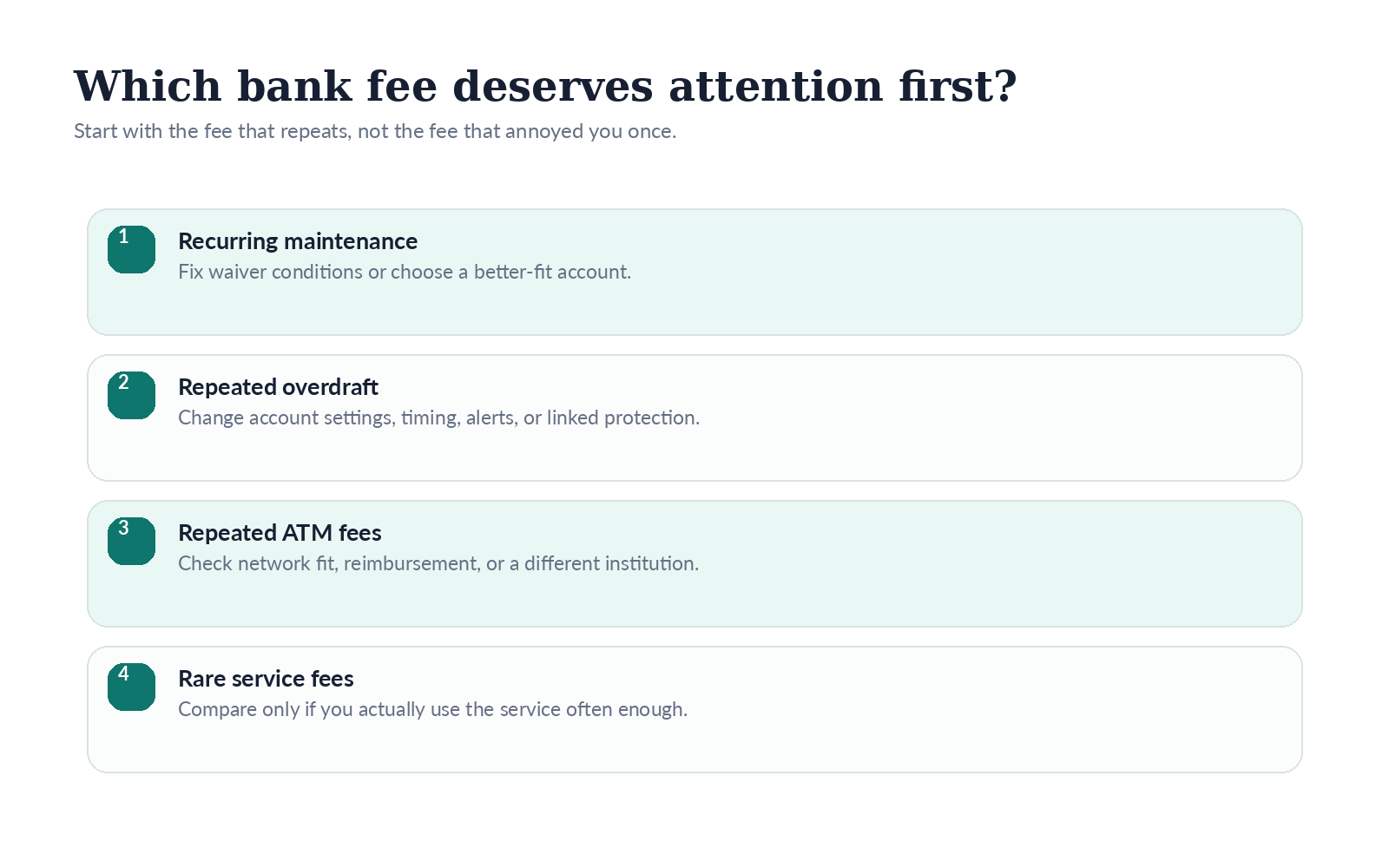
After the audit, divide fees into three buckets.
Recurring and avoidable – fix these first.
Behavior-triggered – change the trigger or account setting.
Rare service fees – compare only if you actually use the service.
Then estimate the annual cost.
Illustrative example
A $12 monthly maintenance fee is $144 a year. Two $35 overdraft fees add another $70. Four $3 out-of-network ATM charges add $12.
That is $226 in a year.
If another account can realistically eliminate most of that without making your banking harder, switching deserves attention.
If the only fee you paid was one $25 stop-payment order after a lost check, changing banks over it probably creates more hassle than savings.
Before you close an account
Do not move fast enough to create new fees.
List every direct deposit and automatic payment tied to the account. Move them. Leave enough money for transactions still pending. Download statements you may need later. Confirm how the institution handles closing and whether there are conditions or fees.
Then keep the old account open long enough to catch stragglers if doing so does not create another maintenance fee.
A clean switch is part of the savings.
What I would fix first
The worst bank fee is not necessarily the biggest one.
It is the fee that keeps repeating because the account and your normal life do not fit each other.
Find the recurring pattern. Fix the setting if you can. Change the account if you cannot.
You should not have to remember a monthly trick forever just to keep your checking account from charging rent.
Sources
- CFPB – Why am I being charged a monthly maintenance fee? — reviewed/updated context: September 13, 2024
- CFPB – Know your overdraft options — reviewed/updated context: June 4, 2025
- CFPB Regulation E §1005.17 – overdraft services — reviewed/updated context: current regulation
Last reviewed: August 25, 2026
Continue the cycle: Previous: Rent the Router or Buy Your Own? Do the Math Before You Decide. · Next: Fixed or Variable Electricity Rate? Choose the Risk You Can Live With.