Why the Urge to Buy Peaks Before You Own the Thing
Impulse spending gets easier when anticipation is high and checkout is effortless. That is useful because the intervention does not have to happen at the register. You can change what happens before the urge becomes a purchase.
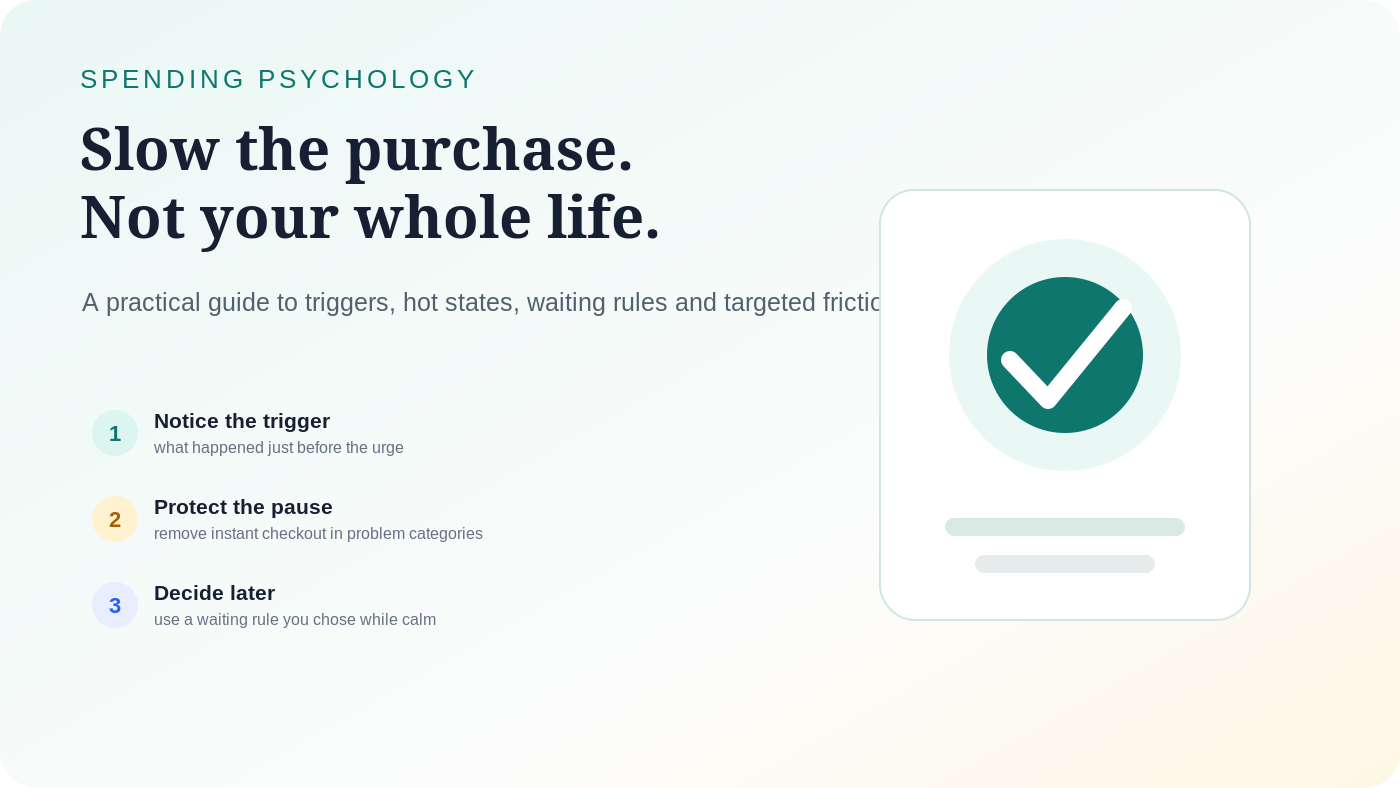
Quick verdict: Do not try to eliminate every urge. Identify the categories where you repeatedly regret purchases, remove one trigger or shortcut, and use a waiting rule chosen while you are calm.
The urge starts before ownership
In a well-known fMRI purchasing study, reward-related activity while people viewed products helped predict later purchases, while price-related signals also mattered.
The careful takeaway is not “shopping is dopamine.”
It is that a purchase decision can start forming before ownership, and several signals — reward, price and anticipated loss among them — can shape what happens next.
Online shopping compresses that process.
A product appears. A countdown starts. A cart reminder arrives. Payment details are already stored.
Convenience is useful. But in a category where you often regret buying, convenience can remove the pause that would have let you reconsider.
Hot state, cold state
Behavioral research on hot–cold empathy gaps describes a familiar problem: preferences can look different when we are emotionally or physiologically aroused than when we are calm.
For shopping, the useful translation is simple.
Do not make the rule at peak urgency.
Make the rule earlier.
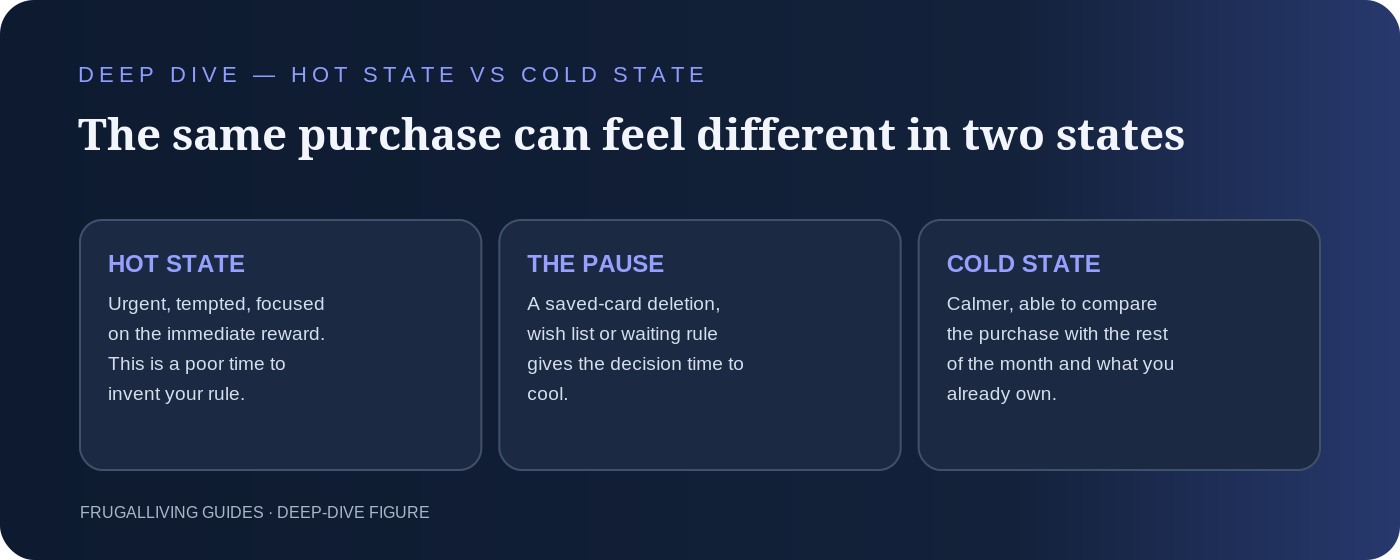
A waiting rule is not proof that the purchase is bad.
It is a way to let a calmer version of the decision participate.
“Impulse” is too vague — name the trigger
Two purchases can look identical on a statement and come from different situations.
Common patterns include:
- reward: “That day was awful. I deserve something.”
- scarcity: “Only two left.”
- social proof: “Everyone seems to have this.”
- boredom: scrolling until shopping becomes the activity.
- identity: buying for the version of yourself you plan to become.
- convenience: the checkout path is so short that the decision feels finished before you examine it.
For one week, do not try to suppress every urge.
Label it.
That turns “I buy too much” into something more useful:
I shop for skincare after late-night scrolling.
I order food when the fridge feels inconvenient.
I buy hobby gear after watching setup videos.
A specific pattern is easier to interrupt.
Build a friction ladder
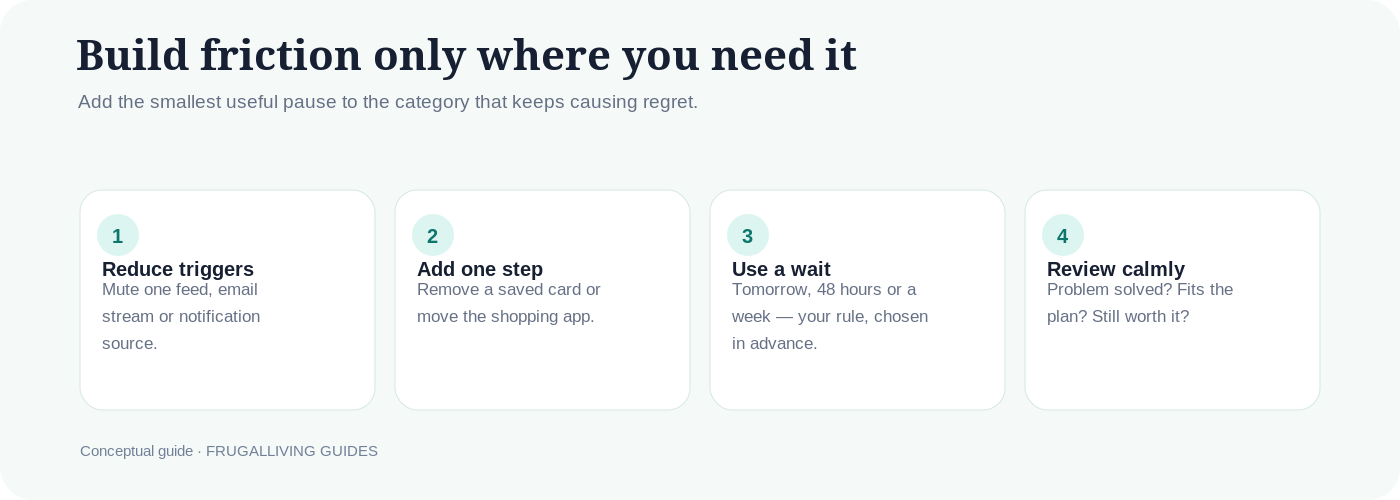
Use the lightest step that works.
1. Reduce exposure where the pattern starts
Unfollow a deal account. Mute promotional notifications. Unsubscribe from the one email stream that repeatedly sends you shopping.
This will not remove every desire.
It can reduce a trigger you already know causes trouble.
2. Remove instant checkout in the problem category
Delete the saved card from one site.
Move the shopping app off the home screen.
Log out.
These are tiny inconveniences. That is the point. You are creating a few seconds in a process designed to remove them.
3. Use a waiting rule
A 24-hour rule is not a scientific threshold. Neither is 48 hours or 30 days.
They are practical rules you choose in advance.
One example:
- small non-essential purchase → revisit tomorrow;
- medium purchase → wait two days;
- large discretionary purchase → put it on a dated wish list for a week;
- recurring subscription → wait until you can name the use case and the cancellation plan.
Adjust the thresholds to your income and household.
The numbers are not sacred. The delay is the tool.
Make the wish list do actual work
A wish list can become a second cart unless it asks a question.
Add three fields:
Date added
Problem it solves
What I would use instead
When you revisit the list, delete what no longer feels relevant.
What remains is more informative than the urgency you felt when a limited-time banner was counting down.
The repeated category can also be useful.
If the list is full of kitchen gadgets, skincare, hobby equipment or productivity tools, the category may deserve a permanent friction rule.
Do not make your whole life inconvenient
Target the weak point.
If you overspend on one shopping site, remove convenience there.
If late-night scrolling is the trigger, change the feed or time window.
If takeout is the issue, the relevant friction may be a backup freezer meal rather than deleting every delivery app.
The goal is not punishment.
It is to make the repeated regret less automatic.
What about paying with cash?
Research has found that payment method can affect willingness to pay in some settings, including classic experimental work comparing credit cards and cash.
That does not mean cash is always better or cards are inherently bad.
But if one category feels unusually easy to overspend in, changing the payment method can be another friction tool.
Use it because it changes your behavior, not because it is morally superior.
What actually helps
Treat impulse buying as a process you can interrupt.
Reduce the trigger you already know.
Add one step to the checkout that is too easy.
Choose a waiting rule while calm.
Review the purchase later.
If you still want it, it solves a real problem and it fits the plan, buy it without turning the decision into a courtroom drama.
The goal is not zero temptation.
It is giving your slower preferences a chance to show up.
Next in this series → The 20-Minute Money Leak Audit — turn the patterns you found into one concrete money fix.
Part of the larger guide: The FrugalLiving Money System.
Sources & further reading
- Knutson, B. et al. (2007), Neural Predictors of Purchases, Neuron / PubMed
- Prelec, D. & Simester, D. (2001), research on payment method and willingness to pay
- Loewenstein, G. and related research on hot–cold empathy gaps in decision-making
- Waiting periods in this article are practical examples, not research-established thresholds.