The Insurance Audit: Cut Costs Without Cutting the Protection You Need
Insurance is one of the easiest bills to resent — and one of the worst places to make a blind cut. A lower premium can be a real win. It can also mean a higher deductible, a lower limit, or a gap you do not discover until after a loss.
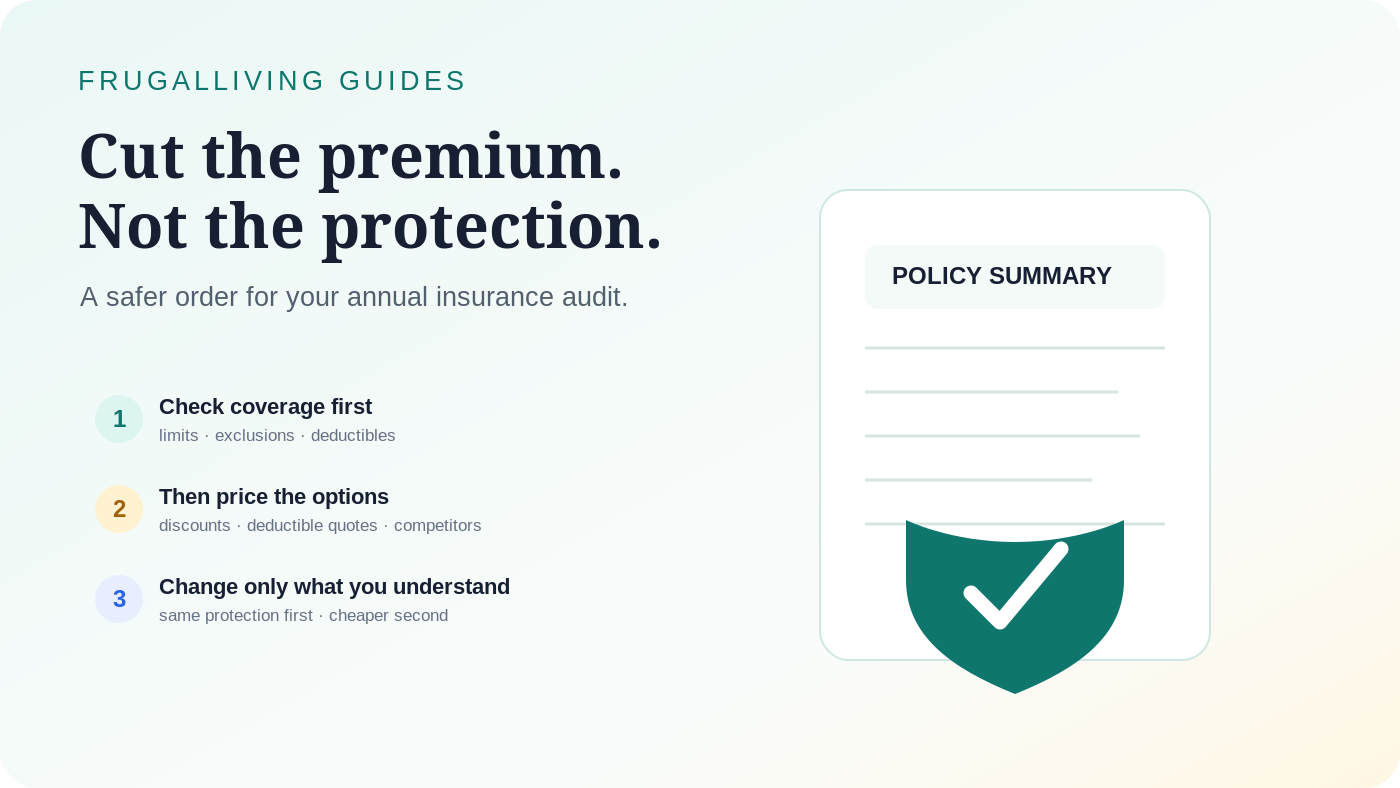
Review insurance once a year and after major life changes. Verify what the policy covers first. Then look for discounts, pricing differences and deductible options. Do not cancel or reduce coverage just because one line item looks expensive.
This guide focuses on common personal policies such as auto, homeowners and renters insurance. Health, life, disability, business and specialty coverage can involve different rules and trade-offs.
Start with the policy, not the price
The tempting way to audit insurance is:
That is backwards.
The National Association of Insurance Commissioners recommends periodically reviewing coverage and reassessing it after life changes. It also advises consumers to verify policy information, check limits and deductibles, ask about discounts, and compare options.
That does not mean every policy is too expensive. It means insurance deserves the same maintenance as any other recurring household bill — with one extra rule:
Never trade away protection you have not understood yet.
1. Verify the boring details first
Before comparing prices, check the information the insurer is using.
Address, drivers, vehicle make/model, mileage or usage assumptions, and discounts already applied.
Address, occupancy, property use, lienholder information, major renovations, and valuable property that may need separate treatment.
A wrong input can distort both price and coverage. This is the least exciting part of the audit. It is also the part that can make every comparison after it more accurate.
2. Map what the policy actually covers
Do not read only the premium. Find the declarations page or policy summary and write down four things:
How much can the policy pay for a covered loss?
How much do you pay before the insurer pays its share on applicable covered claims?
What has been added beyond the standard policy?
What is specifically not covered?
For homeowners insurance, this step matters because a standard policy does not automatically cover every disaster. The NAIC notes that typical homeowners policies do not cover floods or earthquakes, and some locations can have separate wind or catastrophe deductibles.
A cheap policy with the wrong gap is not cheap. It is incomplete for the risk you thought you had transferred.
3. Check whether the limits still match your life
Insurance gets stale.
Your home changes. Construction costs change. You buy equipment. A teenager begins driving. You work from home. You inherit jewelry. You add a shed. You move. You marry. You divorce.
The policy you bought years ago may still renew automatically while the underlying facts have changed.
For homeowners insurance, replacement cost is especially important. Market value and rebuild cost are not the same thing. The NAIC advises reviewing dwelling coverage over time so it continues to reflect replacement needs.
For personal property, a home inventory can make this review much less vague. For liability coverage, ask whether the limit still makes sense for your current exposure rather than assuming the default number is permanent.
The goal is not “more insurance.” The goal is coverage that still matches the thing you are trying to protect.
The safer order for an insurance audit
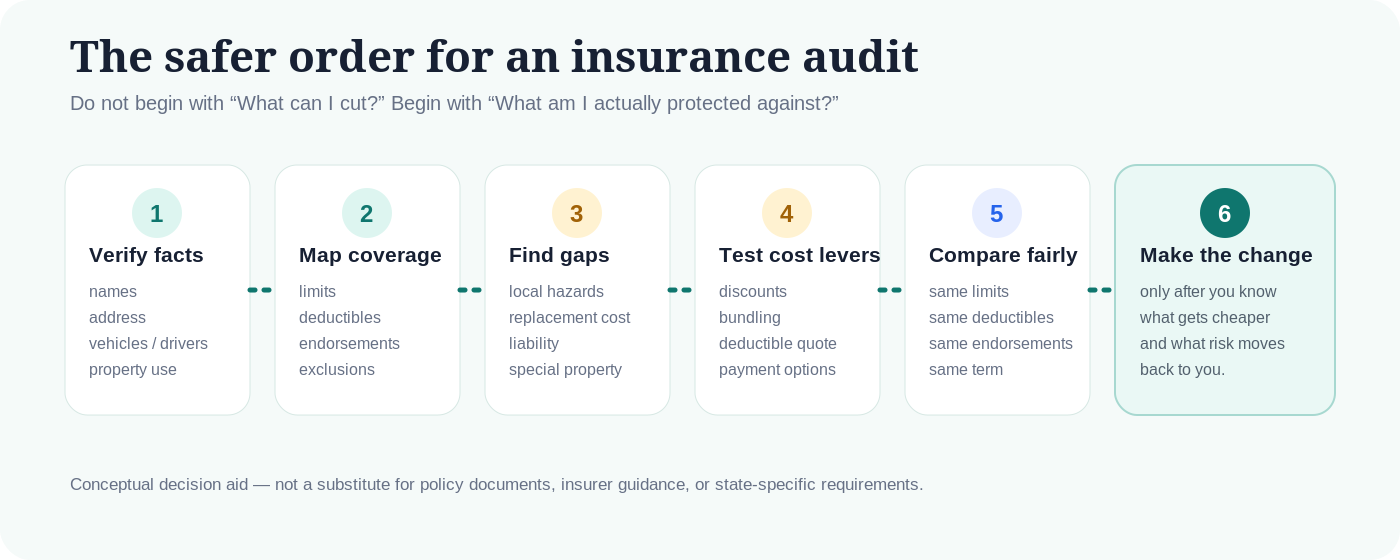
This order matters because cost-saving levers can change risk.
If you start with discounts and comparison quotes, you are mostly shopping. If you start with limits, exclusions and deductibles, you are auditing.
Do the audit first. Then shop.
4. Treat the deductible as a trade-off, not a trick
A higher deductible can lower the premium. That is real.
But the deductible is not free savings. It is a larger piece of the loss that you agree to carry yourself.
The NAIC tells consumers to make sure they can afford the deductible if they have a loss. That is the test to use before celebrating a lower quote.
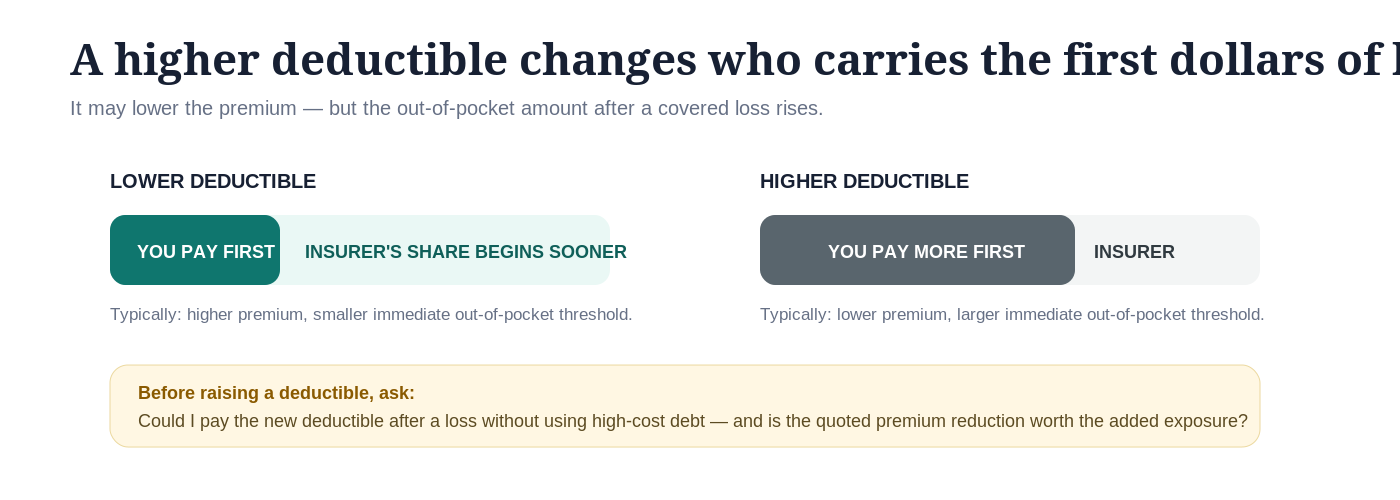
Ask the insurer for actual quotes at different deductible levels. Then compare annual premium savings against additional out-of-pocket exposure.
If a change increases your potential deductible by $500 and lowers the annual premium by $100, five claim-free years of premium savings would equal that additional $500 exposure. This is not a prediction of claims — only a way to see the trade-off.
Also check whether the policy has separate deductibles for specific hazards. Some property policies use percentage deductibles for wind, named storms or other catastrophe risks.
5. Ask for discounts before removing protection
The cheapest reduction is the one that does not reduce useful coverage.
Ask the insurer or agent about discounts you may qualify for. Depending on the company and policy, possibilities can include multi-policy discounts, safety or security features, claims-free discounts, defensive-driving programs, vehicle safety equipment, or other company-specific programs.
Do not assume a discount is already applied. Ask. Then verify it on the policy or quote.
Bundling can reduce price, but do not treat it as automatically cheaper. Compare the total package against comparable separate policies.
6. Compare quotes on the same basis
This is where insurance shopping goes wrong.
Looks easy. But if Quote B has a higher deductible, lower liability limit, missing endorsement or different replacement-cost treatment, you are not comparing the same product.
Before declaring a winner, line up coverage limits, deductibles, endorsements, exclusions, policy term and major rating assumptions.
Same protection first. Cheaper second.
7. Be careful with “small coverage” cuts
Some coverage can become less valuable as circumstances change. That does not mean there is a universal list of things everyone should drop.
For example, whether collision or comprehensive coverage makes sense on an older vehicle can depend on the vehicle’s value, cost of the coverage, loan or lease requirements, deductible, ability to replace the vehicle, and the risks you want to retain.
Likewise, raising a homeowners deductible may be reasonable for one household and financially painful for another.
It is: “If I remove or reduce this, what loss am I agreeing to pay myself?”
If you cannot answer that sentence clearly, do not make the cut yet.
8. Know which decisions deserve verification
Pause before changing anything tied to legal requirements, lender or lease requirements, large liability exposure, location-specific hazards, replacement-cost rules, life or disability protection, health coverage, business use of a home or vehicle, or a policy you do not fully understand.
State rules and policy language vary. Use this audit to identify the question. Then verify the answer with the policy documents, insurer, licensed agent or your state insurance department before changing high-impact coverage.
Your 15-minute annual insurance routine
- Gather the current declarations pages.
- Verify the basic information.
- Write down limits, deductibles and major exclusions.
- Check for obvious gaps or stale assumptions.
- Ask about discounts and deductible options.
- Get comparable quotes if the premium looks uncompetitive.
- Change only what you understand.
- Save the updated documents somewhere you can find them.
Questions to ask your insurer
- What discounts am I currently receiving?
- Are there discounts I may qualify for but do not have?
- What would my premium be at the next deductible level?
- Are any deductibles percentage-based or hazard-specific?
- Are home and personal-property limits based on replacement cost or another valuation method?
- What major exclusions should I understand?
- Have any endorsements changed since last renewal?
- If I change this coverage, what specific loss would no longer be paid the same way?
A vague answer is a reason to ask again.
Sources
- National Association of Insurance Commissioners — Consumer Homeowners Insurance
- NAIC — A Consumer’s Guide to Home Insurance
- NAIC — Your Annual Insurance Check-up
- NAIC — Tips for Saving on Auto Insurance
- NAIC — Why Are My Insurance Premiums Increasing?
Insurance is a contract that moves some financial risk away from you. Understand the protection. Find the gaps. Price the alternatives. Then cut the cost.
Previous: Your Emergency Fund Isn’t a Number — It’s a Buffer
Next: Turn Clutter Into Cash Without Turning It Into a Second Job