How Much Emergency Fund Do You Actually Need?
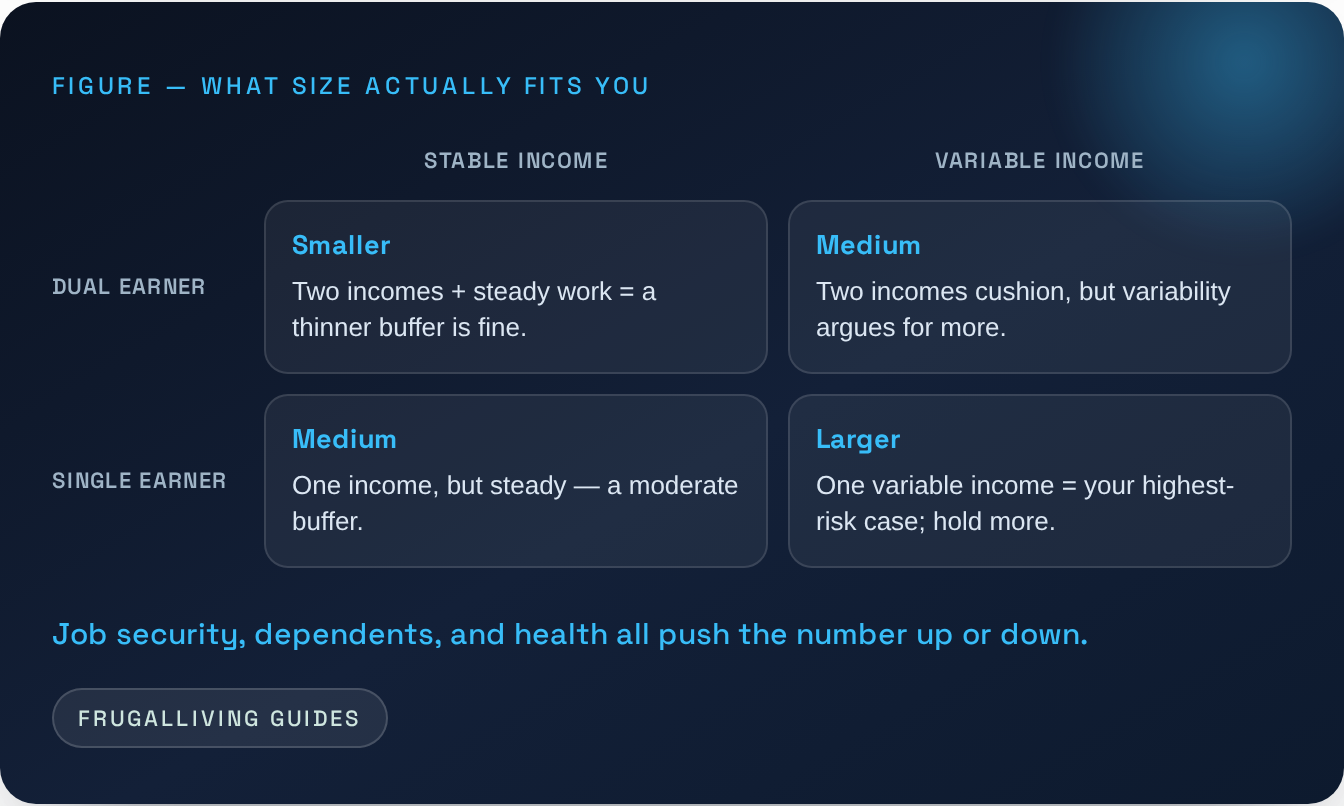
“Save three to six months” is a useful rule of thumb, not a personal diagnosis. Your real target depends on how stable your income is, how many people rely on it, and what kind of surprise would force you to borrow.
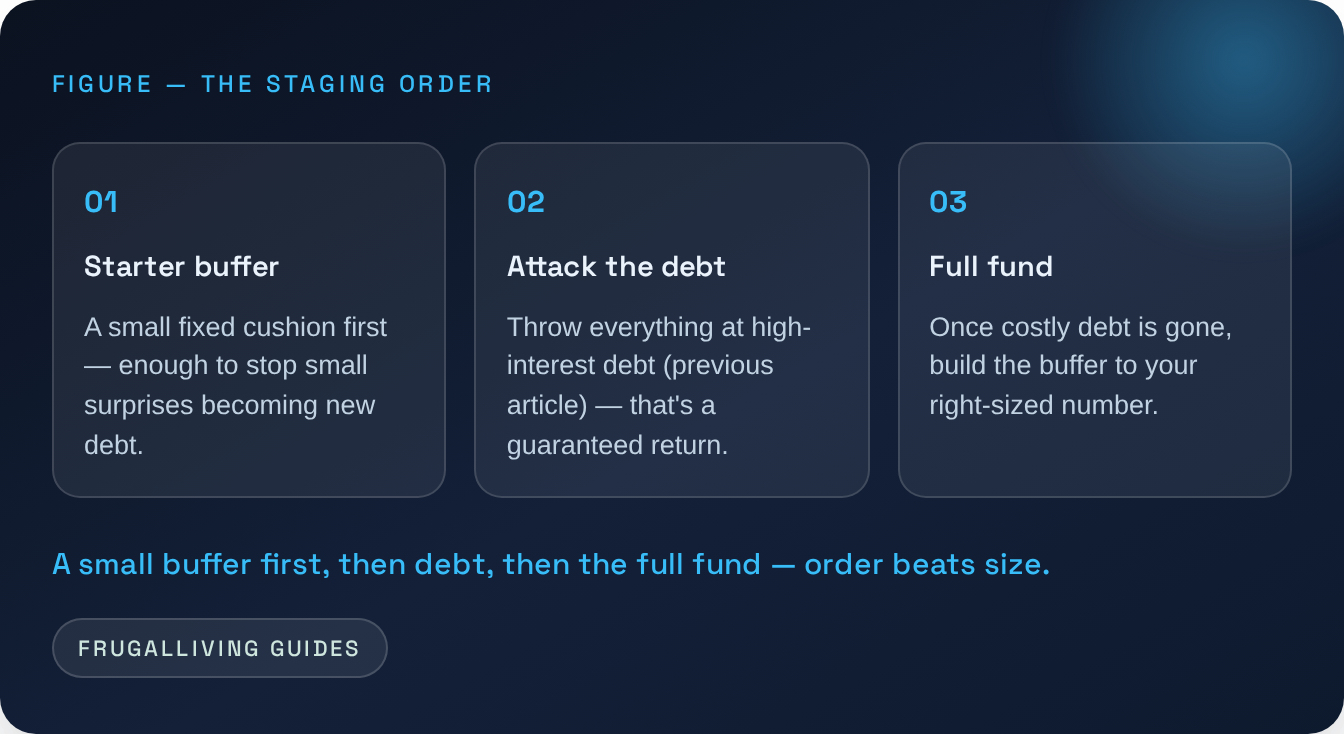
Before you throw everything at debt, one buffer comes first — otherwise a single surprise expense drops you right back onto the credit card and erases months of progress. How real is that risk? In the Federal Reserve’s 2025 household survey, released in May 2026, 63% of U.S. adults said they would cover a hypothetical $400 emergency expense completely using cash or its equivalent. The rest would need another approach, including borrowing, selling something, or being unable to cover it. That is the kind of short-term shock emergency savings are meant to absorb.
Why the one-size rule is wrong both ways
An emergency fund exists to absorb income shocks and unplanned costs without borrowing. How big that needs to be depends entirely on how likely and how severe your shocks are — which varies enormously from person to person. The common three-to-six-month range can be a useful benchmark, but it may be too small for a household with fragile income and more than necessary as an immediate cash target for someone with unusually stable income and strong backup resources.
Save too little and the fund’s whole purpose fails: the first real emergency puts you back in debt. Holding far more cash than you reasonably need also has an opportunity cost, especially while expensive debt is accruing interest. Both errors have a price. The goal is to right-size, not to hit a slogan.
Build it in the right order
You don’t fund the whole thing before doing anything else — that can leave someone building cash slowly while much more expensive card debt keeps compounding. Stage it:
Where to keep it (and where not to)
An emergency fund has one job: be there, in full, the instant you need it. That rules out anything locked up or anything that can drop in value the moment you need to withdraw. The tension is liquidity versus return, and for this money, liquidity wins outright.
- Keep it accessible — reachable within a day or two, no penalties, no paperwork. A separate high-interest savings account is the classic home.
- Keep it separate from your spending account, or it quietly gets spent. Out of sight is the point.
- Don’t invest the core emergency reserve in assets that can fall sharply just when you need the cash. Growth is for money with a longer time horizon, not the buffer you may need next month.
- Don’t lock it in anything with an early-withdrawal penalty. An emergency fund you can’t reach in an emergency isn’t one.
Build two targets: “stops a bad week” and “protects a bad season”
One giant emergency-fund number can be discouraging.
Split it.
Target 1: a starter buffer.
Enough to handle the kind of surprise that would otherwise go straight on a credit card: a repair, deductible, urgent travel, or a few days of lost income.
Target 2: a resilience buffer.
Enough to help when the problem lasts longer — job loss, a major health disruption, caregiving, or a long repair cycle.
The first target buys breathing room. The second buys time.
That distinction also explains why “three to six months” is useful but incomplete. Someone with stable dual incomes, low fixed costs and strong insurance may need a different buffer than a single-income household with dependents and variable work.
Calculate the number from essential expenses, not your lifestyle total
If you use a months-of-expenses target, start with what you would still need during a disruption:
- housing;
- basic food;
- utilities;
- insurance;
- minimum debt payments;
- essential transportation;
- necessary medical and caregiving costs.
You may pause travel, entertainment and discretionary shopping. The emergency number should reflect the cost of staying functional, not the cost of maintaining a normal month unchanged.
Then add risk. A volatile income, older car, high insurance deductible, homeownership, dependents or limited family support can justify a larger buffer.
The Federal Reserve number is a stress signal, not your target
In the Federal Reserve’s 2025 SHED, released in May 2026, 63% of adults said they would cover a hypothetical $400 emergency completely using cash or its equivalent. Among those who would not, some would use credit and carry the balance, borrow, sell something, or be unable to pay the expense at the time.
That statistic is useful because it shows how quickly a small shock can become debt.
It does not mean $400 is a complete emergency fund.
Think of $400 as a test of immediate liquidity, not a prescription.
When you use the fund, the next job is rebuilding it
Spending emergency savings on an actual emergency is not “falling behind.” That is the job the money was hired to do.
After the event:
- stop the automatic transfer only if cash flow genuinely requires it;
- re-check your target — the emergency may have revealed that it was too low;
- restart contributions at a sustainable amount;
- if a recurring cost caused the emergency, consider whether it belongs in a sinking fund instead.
A repair that happens every year is not an emergency. It is a budget category wearing a fake mustache.
Small shocks handled. What about the big ones?
An emergency fund is built for the medium surprise — the car, the boiler, a gap between jobs. It is not built for the catastrophic: the event that would cost more than any reasonable savings pile. Those need a different tool entirely — and most people are simultaneously overpaying for it and underprotected by it. Next: the insurance audit.
Size it to your risk
Use the rule of thumb as a starting point, then adjust for your actual risk. A small starter buffer can protect against everyday shocks; a larger reserve can protect against income loss. Keep emergency money liquid, separate from routine spending, and free from market risk.
Next in this series → Insurance Audit: What to Keep, Cut, and Check — use insurance for losses you cannot comfortably absorb, then look for overlap and weak spots.
Part of the larger guide: Why You Can’t Save Money — And the System That Fixes It.
Continue the money-saving cycle
- Previous: How to Pay Off Debt in the Right Order
- Next: Insurance Audit: What to Keep, Cut, and Check
Sources & further reading
- Federal Reserve, Economic Well-Being of U.S. Households in 2025 (May 2026) — https://www.federalreserve.gov/publications/2026-economic-well-being-of-us-households-in-2025-savings-investments.htm
- Federal Reserve data visualization, unexpected $400 expenses — https://www.federalreserve.gov/consumerscommunities/sheddataviz/unexpectedexpenses.html
- Consumer Financial Protection Bureau, An essential guide to building an emergency fund — https://www.consumerfinance.gov/an-essential-guide-to-building-an-emergency-fund/
- “Three to six months” is a planning benchmark, not a universal requirement.